

How to Start a Delivery Company in Saudi Arabia: An Operations Guide
An operations-first guide to starting a delivery or logistics company in Saudi Arabia: the business model, warehouse, fleet, drivers, cash on delivery, proof and the permissions to confirm.
Tafsee Team · · 7 min read
Saudi Arabia is a country of online orders, new warehouses and constant deliveries, so it is no surprise that many people ask how to start a delivery company in Saudi Arabia. This guide is about operations: the things you will actually build and run, in the order they usually matter. It is not legal advice, and where rules are involved we tell you which authority to ask.
A note on regulation, up front
Delivery and logistics activities are generally regulated, and the permissions that apply depend on what exactly you do: carrying goods for others, running a warehouse, operating an app, employing drivers, importing or holding customs goods. Typically you should expect to deal with the commercial registration side through the Ministry of Commerce, transport activity through the Transport General Authority (TGA), tax and e-invoicing through ZATCA, and local permits for premises through the municipality. Rules and requirements change, so confirm everything directly with the Transport General Authority, the Ministry of Commerce, ZATCA and your municipality before you commit money. We do not state any specific requirement or fee in this article on purpose.
The big picture: logistics in Saudi Arabia and Vision 2030
Logistics in Saudi Arabia is discussed a lot in the context of Vision 2030. In general terms, the Kingdom aims to become a logistics hub linking three continents, and there is a national transport and logistics strategy supporting that goal. For a small operator this does not mean a guaranteed customer, but it does mean growing attention to warehouses, ports, roads and last-mile delivery. We do not quote market-size figures, because they differ between sources and change often. Check official publications for current numbers when you write a business plan.
Step 1: Decide what kind of company you are starting
The words delivery and logistics cover several different businesses. Choose one to start with.
- A local delivery company that collects goods from shops or warehouses and delivers to homes and businesses.
- A delivery service for one business, such as your own online store, with your own drivers.
- A warehouse and delivery business, which receives goods, stores them and delivers on behalf of other companies. See what is a 3PL.
- A delivery app or platform that connects customers and independent drivers. This tends to attract more regulatory attention, so ask the TGA early about what permissions apply to a delivery app.
Each has different cash needs, different staff and different risks. A company that tries to be all four in year one usually does none of them well.
Step 2: Choose your customers and your area
Pick a city, or part of one, and a type of customer: online shops, distributors, furniture and appliance sellers, importers. Dense areas make deliveries cheaper per stop. Writing down your first ten target customers and what each one needs will teach you more than a long business plan.
Step 3: Plan the warehouse, if you need one
If you hold goods for customers, you need a warehouse. A warehouse licence in Saudi Arabia, and the permits for the premises, depend on the activity and the location, so confirm the type of permission with the relevant authority and the municipality before signing a lease. Operationally, plan these things from the start:
- A receiving area where every arrival is counted and recorded.
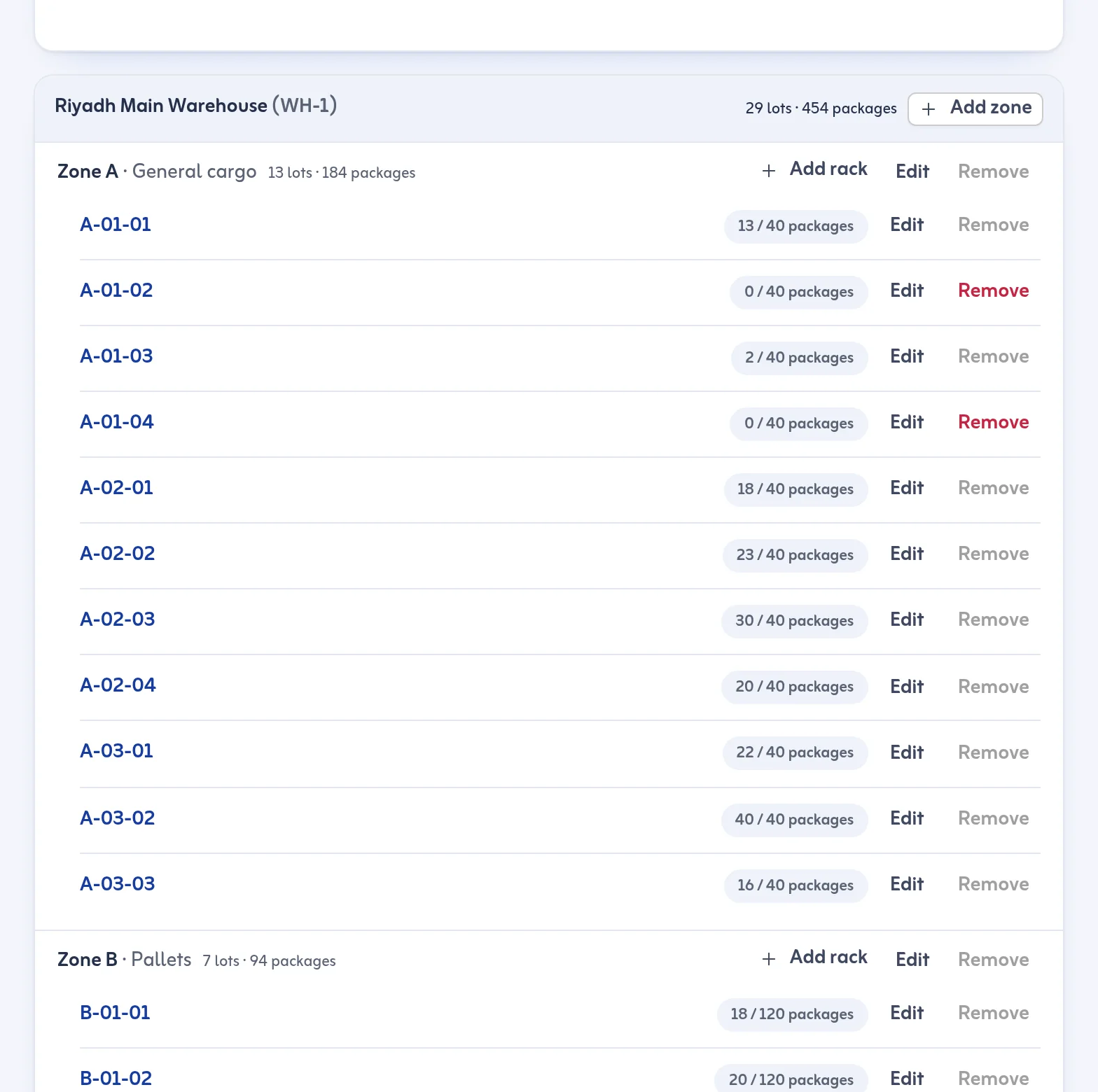
- Zones and racks with short codes, so a lot always has a place. See zones and racks.
- A barcode on every package.
- A rule for goods that must wait, such as for documents or payment. See holds and approvals.
- A regular stock count.
Step 4: Build your fleet and your driver team
Start with the fewest vehicles you can keep busy. A motorcycle, car, van or pickup each suit different loads. For each vehicle, keep the registration, insurance and periodic inspection documents and their expiry dates in one place, and do the same for each driver's licence and identity details. Expired documents are a compliance and safety problem and a reason a trip should not go out. See drivers and vehicles.
Decide early whether drivers are employees or contracted, and confirm the rules for that with the authorities and a qualified adviser. Then write down simple working rules: when the day starts, how goods are handed to the driver, what the driver does when nobody answers, and how the day is closed.
Step 5: Solve addresses before they solve you
The biggest daily cost of a delivery company is the wasted trip. A large share of those come from vague addresses. Collect the national address fields where possible: building number, street, district, city, postal code and additional number, or the short address. Ask customers to pin their exact door. Read national address for delivery and how to reduce failed deliveries.
Step 6: Cash on delivery and proof of delivery
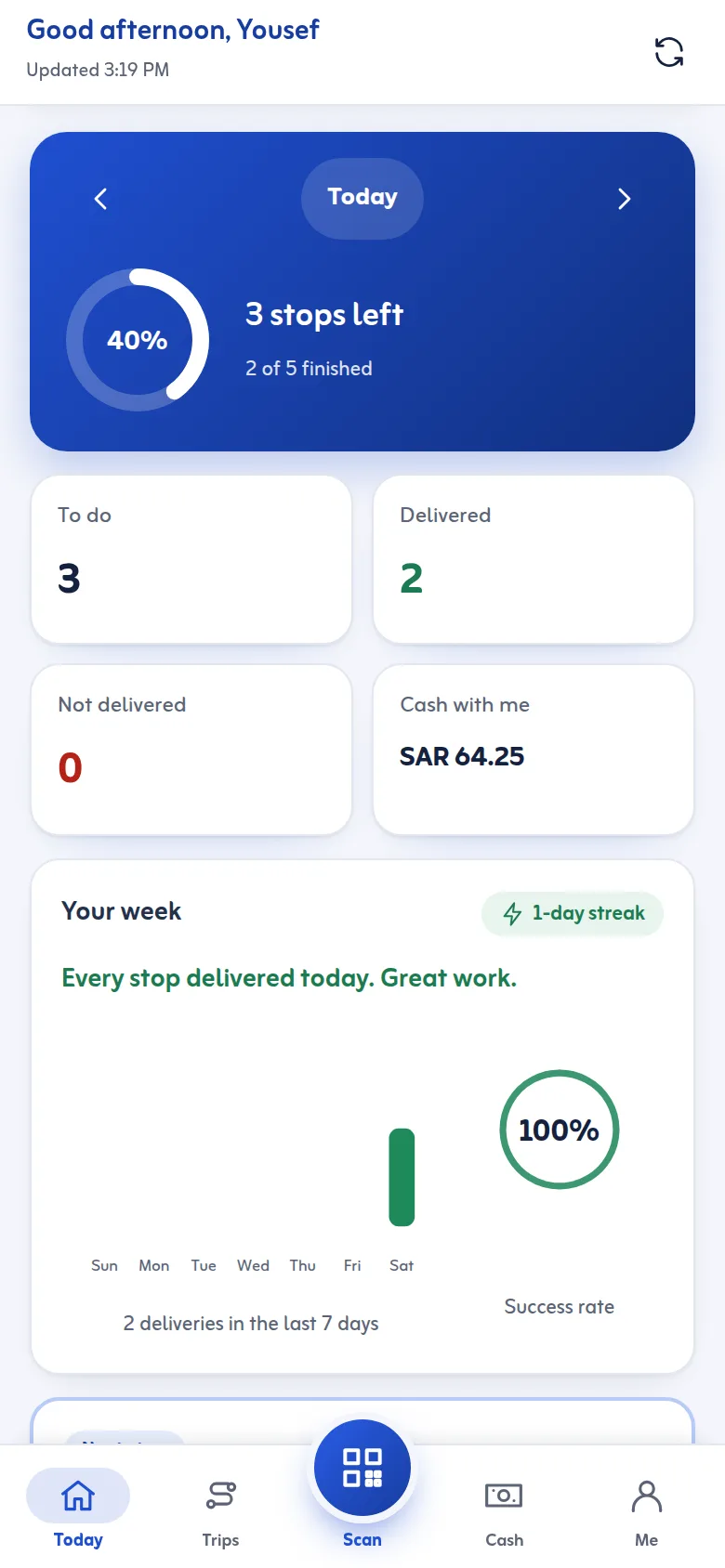
Many customers in Saudi Arabia still pay at the door, so your drivers will carry cash. You need a clean routine: the amount per stop is fixed before the trip, the driver records what was collected, and the office counts it against the expected total with a note for any difference. See cash on delivery in Saudi Arabia.
Pair it with proof of delivery: a code the customer gives, or a signature, and a photo when needed. Proof protects you from disputes and your driver from accusations. See what is proof of delivery.
Step 7: Money, tax and e-invoicing
Like other businesses, a logistics company issues e-invoices under ZATCA rules, so plan for invoicing from day one and confirm the requirements with ZATCA. Tafsee Logistics does not issue invoices. Tafsee's accounting product, Tafsee Books, does ZATCA e-invoicing for Saudi businesses, and you can read about it at /sa/books. Keep the operational records in your warehouse and delivery system, and the financial records in your accounting system.
Step 8: Choose software early, but keep it simple
Starting with phone calls and a spreadsheet is understandable, but the records you create in the first months become the proof you rely on later. Pick tools that match your model. For warehouse-to-door work, see how to choose warehouse management software and how to choose delivery management software.
A launch checklist
- Choose the business model and the first area.
- Confirm the permissions with TGA, the Ministry of Commerce, ZATCA and the municipality.
- Secure the premises and set up zones, racks and labels.
- Register vehicles and drivers with their documents.
- Set your delivery services, areas and charges.
- Decide your proof of delivery rules and your cash routine.
- Run a pilot week with a friendly customer.
- Review failures by reason and fix the top one.
Where Tafsee Logistics fits
Tafsee Logistics is warehouse-to-door software for Saudi businesses that receive goods into a warehouse and deliver them locally. It records arrivals with a barcode per package, manages zones and racks, holds and approvals, delivery trips, a driver app in the phone browser, proof of delivery, cash on delivery and reports, in Arabic and English. It does not issue invoices, hold licences for you or advise on regulation. Visit the Tafsee Logistics page and the plans, with a free plan and a 14-day trial.
A note on ZATCA e-invoicing: a logistics company issues e-invoices like any other Saudi business, so plan for it from the first invoice (ZATCA e-invoicing for a logistics company is handled in accounting software such as Tafsee Books, not in Tafsee Logistics).
How to start a logistics company in Saudi Arabia
A logistics company that stores goods for others adds a warehouse to everything above: racks with codes, a receiving routine, holds for customs or payment, and one record per customer's lot. Start with one warehouse and one delivery area, and grow from there.
Warehouse license (Saudi Arabia)
Which licence a warehouse needs depends on the activity, the goods and the city, and bonded storage has its own customs approval. Confirm the current requirements with the Ministry of Commerce, the municipality and ZATCA before you sign a lease.
Delivery app license (Saudi Arabia, TGA)
Delivery activities and delivery apps are regulated by the Transport General Authority (TGA). Ask the TGA which permission applies to your model (your own fleet, contracted drivers or an app) before you start.
Logistics in Saudi Arabia: Vision 2030 and the Saudi logistics market
Saudi Vision 2030 aims to make the Kingdom a logistics hub, backed by a national transport and logistics strategy. For a new company the practical effect is a Saudi logistics market where customers expect tracking links, proof of delivery and Arabic service as standard.
Questions
Frequently asked questions
Choose your business model and area, confirm the permissions that apply with the relevant authorities, set up your warehouse if you need one, register vehicles and drivers, and build routines for addresses, cash on delivery and proof of delivery.
Typically the Transport General Authority (TGA) for transport activity, the Ministry of Commerce for registration, ZATCA for tax and e-invoicing, and the municipality for premises. Confirm directly, as requirements change.
No. Tafsee Logistics does not issue invoices. Tafsee Books, Tafsee's accounting product for Saudi businesses, does ZATCA e-invoicing.
Yes, if it receives goods into a warehouse and delivers them locally in Saudi Arabia. Every plan starts with a 14-day free trial.
More articles
Receive your first shipment today
Try everything in Growth free for 14 days, then choose a plan. No card is needed.
- Arabic and English
- Built for Saudi Arabia, in SAR
- Nothing to install

Warehouse & delivery
Tafsee Logistics
Receive goods with a barcode on every package, hold them until they are cleared, then plan delivery trips with proof at every door.