

How to Reduce Failed Deliveries: 10 Practical Steps
Every failed delivery costs a trip, time and a customer's patience. These ten steps address the usual causes: addresses, contact, timing, capacity and follow-up.
Tafsee Team · · 6 min read
A failed delivery is not only a missed handover. It is a van that drove to an address for nothing, a package that will be driven there again, a customer who is annoyed and often a phone call between the driver and the office that nobody planned. If you deliver every day, even a modest rate of failures adds up to a lot of lost time. The good news is that most failures have a small number of causes, and most of them can be reduced.
Why deliveries fail
The reasons fall into a few groups:
- Address problems: wrong, incomplete or impossible to find.
- Contact problems: the customer is not reachable, or the number is wrong.
- Timing problems: the customer is not there at the time of arrival.
- Refusal: the customer no longer wants the goods or does not have the cash.
- Goods problems: damage, missing packages or goods that should not have left the warehouse.
- Vehicle problems: an overloaded or late van that cannot finish its route.
10 steps to reduce failed deliveries
1. Collect a better address
Use the Saudi National Address fields, not just a district and a street, and add a map pin where you can. Read the National Address for delivery for what to collect.
2. Get a pin, not a description
A precise map location lets a driver find the door without calling. If the customer is not near the address when ordering, send a link they can open on their phone to pin it themselves.
3. Check the phone number
Check that the number is a valid mobile number when you enter it. A single wrong digit becomes a failed delivery days later.
4. Release only goods that are ready
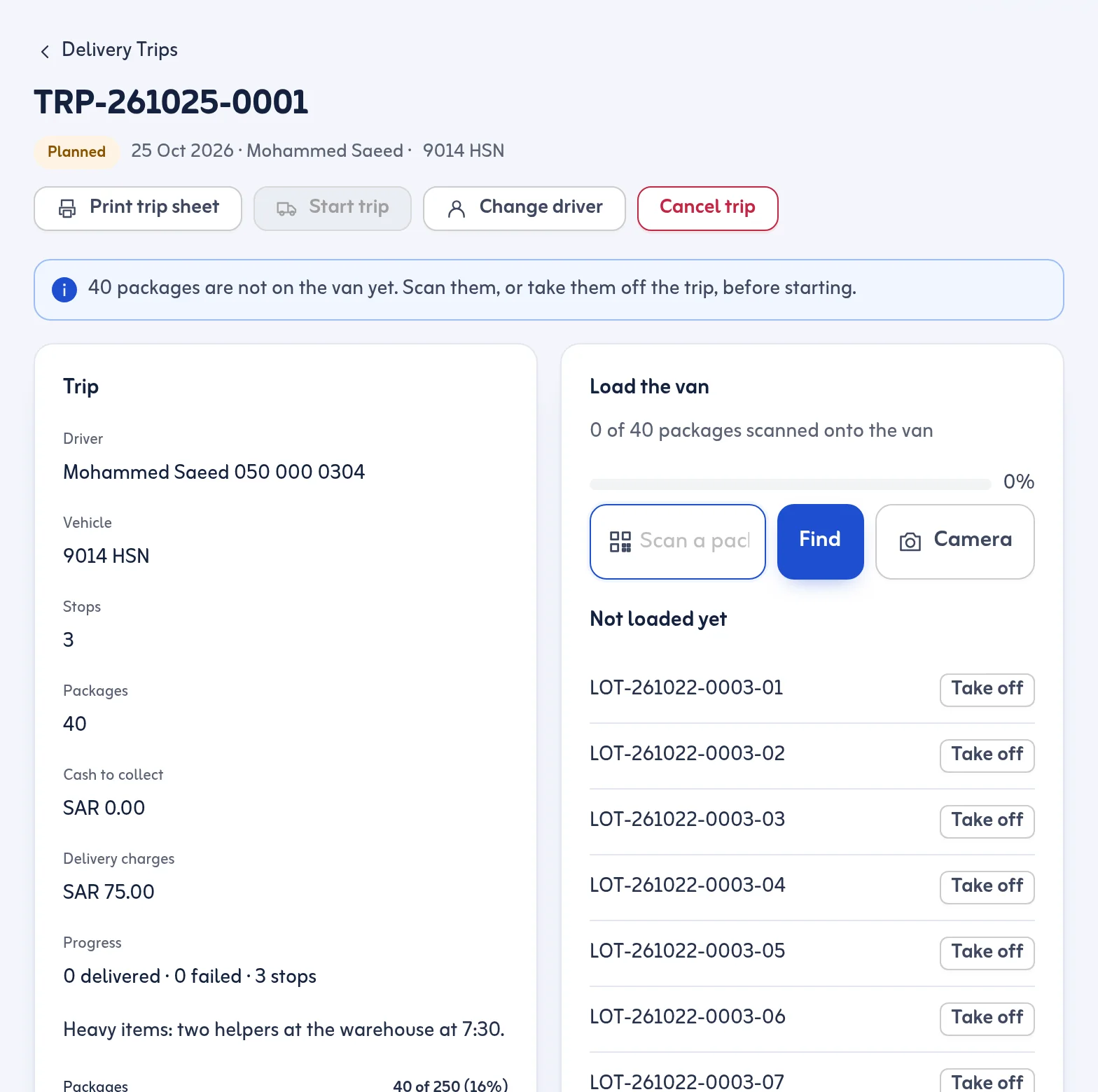
Do not send lots that are unapproved, still on a hold, unpaid or incomplete. Many failed deliveries begin as a warehouse mistake. See holds and approvals.
5. Tell the customer what to expect
Customers who know a delivery is coming, and what to have ready, are more likely to be there. A tracking link showing the status removes many 'where is my order?' calls.
6. Plan trips by district
Shorter trips with fewer kilometres between stops mean fewer delays, and fewer customers waiting too long and giving up. Put urgent deliveries first.
7. Do not overload the van
A van that is full beyond its capacity in packages, kilograms or cubic metres runs late and leaves stops undone. Check capacity when you plan the trip, not at the door.
8. Record the reason, in plain words
A driver should choose a clear reason for each failure: not at home, wrong address, refused, no cash and so on. Reasons you can count are reasons you can fix. If most failures are 'wrong address', train the people who take orders, not the drivers.
9. Decide the next step for every failure
A failed package must not disappear. Decide the three options: try again, return to stock or return to the sender, and record which one with a note. Set a limit on attempts so one package is not driven out again and again.
10. Check returned goods before they go out again
When goods come back, check them in by scan and inspect them. If they are damaged, deal with that before a new delivery attempt.
Measure it
You cannot improve what you do not count. Look at your failure rate by reason, by driver and by district over a few weeks. Look at how many deliveries succeeded on the first attempt, and which areas need better addresses. Compare proof types too, so you know how many deliveries were confirmed by code and how many by signature. For more on proof, read what is proof of delivery.
Common mistakes when handling failures
- Calling every failure 'customer not available'. If the real cause was a wrong address, you will never fix it.
- Retrying the same day without checking. A call to the customer first often saves a wasted trip.
- Letting returns sit in the van. A package must be checked back in so it is in exactly one place.
- No limit on attempts. One difficult address can eat a week of trips.
- Blaming drivers for office mistakes. Missing phone numbers and incomplete addresses are usually entered before the driver ever sees them.
A worked example
These numbers are made up to show how to read your own data. Suppose that in one week you made 200 deliveries and 20 failed. Counting by reason gives: 9 wrong or incomplete address, 6 customer not available, 3 refused, 2 no cash. The biggest group is addresses, so the fix is at order entry: ask for the full address and a map pin, and check the phone number. If the next week shows 4 address failures instead of 9, the change worked. Without the reasons, all you would know is that 20 deliveries failed.
A weekly routine
- Look at the list of failed deliveries waiting for a decision.
- For each, call the customer, correct the address or phone and choose: try again, return to stock or return to sender.
- Check in every returned package by scan.
- Inspect returned goods before they go out again.
- Review the failures by reason and pick one cause to fix this week.
Talking to the customer
Customers are usually patient when you are clear. Tell them the day and the window, ask them to confirm the address, and say what code or signature will be needed. After a failed attempt, explain what happens next and when, in plain words. A customer who knows the plan is far more likely to be home for the second attempt.
When to stop trying
Every business needs a point where it stops. Decide the maximum number of attempts, then return the goods to stock or to the sender with a note. This protects your drivers' time and gives the customer a clear answer.
How Tafsee Logistics handles failed deliveries
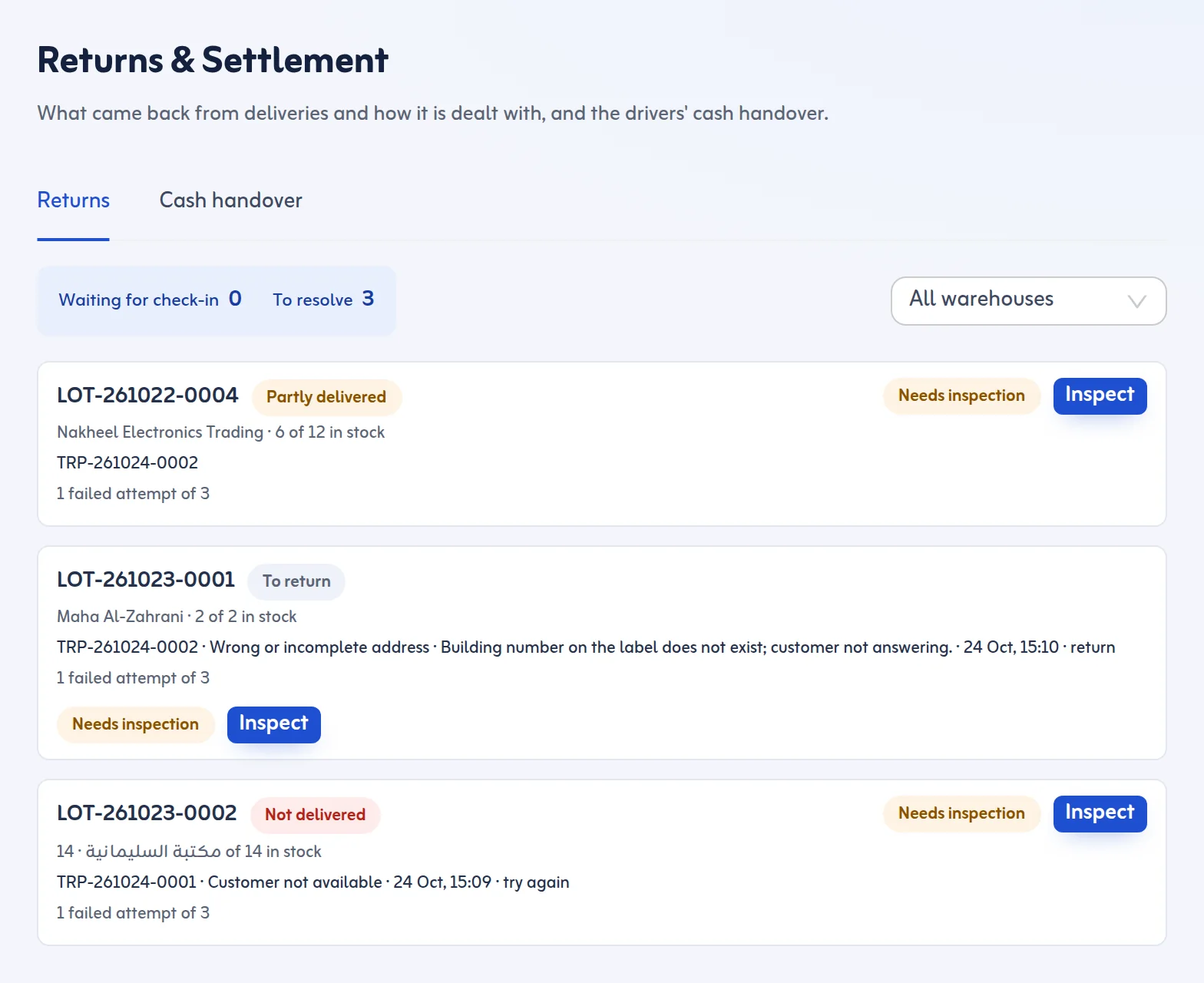
In Tafsee Logistics the driver records a failure reason, and you can add your own reasons in Settings. Failed and partly delivered stops stay in Returns & Settlement until resolved: try again, return to stock (with a check-in scan) or return to sender (with a note and destination). Returned lots must be inspected as good or damaged before they go out again. You set the maximum delivery attempts before return, from 1 to 9.
Drivers can call or message the customer in one tap from the driver app; a plain tel: and WhatsApp link, not a sending account. The dashboard shows failed deliveries awaiting a re-attempt, the Delivery report shows failures by reason, and the team gets an email when a delivery fails. See returns and settlement, customer map pins and the Tafsee Logistics overview. Try it with the 14-day trial.
Questions
Frequently asked questions
It depends on your business, which is why you should record a reason for every failure. Addresses and unreachable customers are common causes, but count yours before deciding what to fix.
That is your business decision. In Tafsee Logistics you set the maximum attempts before a package is returned, from 1 to 9.
It stays in Returns & Settlement until you try again, return it to stock or return it to the sender, each recorded with a note.
No. There is no SMS or WhatsApp sending account. Customers get a tracking link and optional emails, and drivers call or message them with the phone's own apps.
More articles
Receive your first shipment today
Try everything in Growth free for 14 days, then choose a plan. No card is needed.
- Arabic and English
- Built for Saudi Arabia, in SAR
- Nothing to install

Warehouse & delivery
Tafsee Logistics
Receive goods with a barcode on every package, hold them until they are cleared, then plan delivery trips with proof at every door.