

What Is Proof of Delivery (POD)? Types, Examples and Best Practice
Proof of delivery is the record that shows a package reached the right person. Learn the main types, what a good record contains and how to use it to settle disputes.
Tafsee Team · · 6 min read
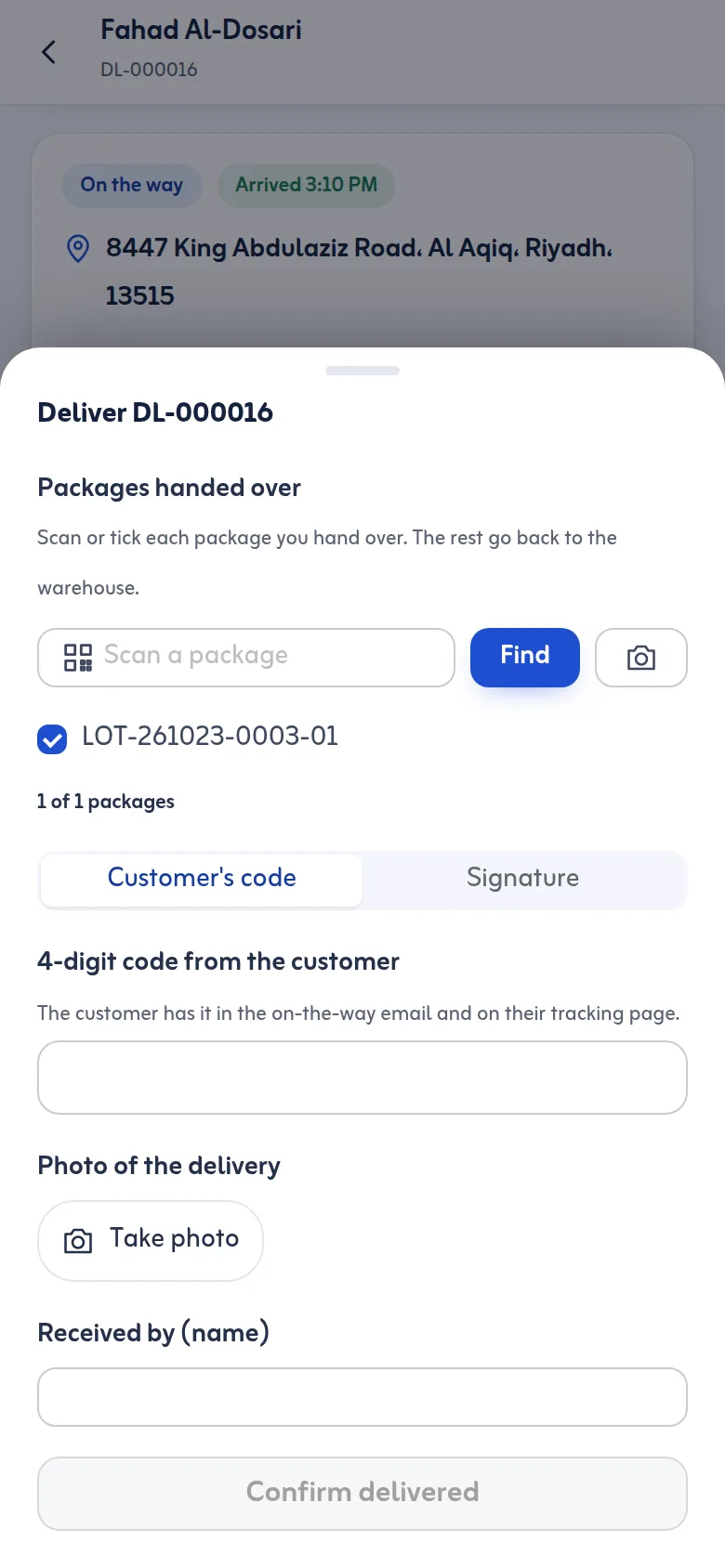
A customer says the package never arrived. The driver says he handed it over. Without any record, it is one person's word against another's, and the business usually loses the argument, the money or the customer. Proof of delivery exists to prevent that situation.
What is proof of delivery?
Proof of delivery, often shortened to POD, is a record showing that goods were handed to the right recipient at the right place and time. Paper versions used to be a signed delivery note. Today a driver's phone usually captures the proof and it is saved against the delivery electronically, which is why you also see the term ePOD.
Why proof of delivery matters
- It settles disputes. A clear record answers the question quickly and fairly.
- It protects the driver and the customer, not just the company.
- It supports billing. Many businesses only count a delivery as complete when proof exists, and cash on delivery relies on it. See cash on delivery in Saudi Arabia.
- It shows where the process fails. Failed deliveries with reasons teach you how to improve. See how to reduce failed deliveries.
Types of proof of delivery
Signature
The recipient signs on paper or on the driver's phone screen. It is familiar and widely accepted. Its weakness is that a scribble does not always prove who signed, so many businesses pair it with the recipient's printed name.
Delivery code (one-time code)
The customer receives a short code in advance, often four digits, and gives it to the driver at the door. If the code matches, the right person has the goods. A code is quick, needs no writing and is hard for anyone else to fake, because only the customer should know it. It should have a limit on wrong attempts and a fallback for customers who cannot find the code.
Photo
The driver photographs the goods at the door, or the recipient with the goods. A photo adds context: the address, the condition of the packages and the place they were left. It is also helpful for safe-place deliveries when nobody is home, if your business allows them.
Received-by name
Even a simple name of the person who took the goods is useful, especially in offices and buildings with reception desks.
Location check
Recording where the stop was completed and comparing it with the customer's address or map pin helps flag deliveries completed far from where they should be.
What a good delivery record contains
- The delivery or lot reference and each package delivered.
- The date and time.
- The driver and vehicle.
- The type of proof: code verified, signature or photo.
- The name of the person who received it.
- For partial deliveries, which packages were handed over and which came back.
- For failed deliveries, the reason in plain words.
- Any cash collected and its amount.
Best practice for drivers and offices
- Decide the rule once. Choose which proofs you accept and which are mandatory, and apply it to every driver.
- Do not take proof early. Collect it when the goods are in the customer's hands, not before.
- Keep drivers away from the code, if you use codes. The driver should only enter what the customer says.
- Limit attempts. After several wrong codes, ask for a signature instead.
- Keep records searchable. The office should find a delivery by customer name, phone or reference in seconds.
- Share only what is needed with the customer; a tracking page with the status is usually enough.
How proof connects to the rest of delivery
Proof of delivery is the final step of the chain: goods are received and labelled, approved, planned onto a trip, loaded and delivered. When each stage is recorded, proof is not a separate chore but the last line of one continuous story. For the earlier stages, read about last mile delivery.
Common mistakes with proof of delivery
- Treating proof as optional for 'easy' deliveries. The delivery that you did not bother to record is the one that is disputed.
- Accepting a signature with no name. A scribble alone says very little. Record who received the goods.
- Letting the driver see or choose the code. The point of a code is that only the customer knows it.
- Photographing the wrong thing. A photo of a closed door says nothing. Photograph the goods at the place they were handed over.
- Keeping proof in the driver's phone gallery. If the office cannot search for it, it is not really a record.
- No plan for partial deliveries. Say which packages were handed over and which came back, or the next dispute is about the missing boxes.
Special cases to decide in advance
Someone else receives the goods
A security guard, a receptionist, a neighbour or a family member may take the package. Decide whether you allow this, and if you do, require the name of the person and, ideally, a photo.
Nobody is home
Decide whether goods may ever be left in a safe place. Many businesses do not allow it for valuable goods or cash on delivery, and treat it as a failed delivery instead.
The customer disputes the quality
Proof of delivery shows that goods were handed over, not that the customer was happy with them. Keep photos from the warehouse and from the door, so condition can be compared.
A worked example
This example uses made-up numbers only to show the idea. A driver has 12 stops on one trip. Ten are finished with the customer's code, one with a signature because the customer could not find the code, and one fails because nobody answered the door. In the evening the office sees 11 deliveries with proof and one failure with its reason in plain words. The next morning a customer says the package never came. The office opens that delivery, sees the proof used, the time, the name of the person who received it and the driver, and answers in a minute instead of starting an investigation.
Questions to ask about your own process
- Which proof types do we accept, and are they the same for every driver?
- Can the office find the proof for any delivery in under a minute?
- What happens after a customer enters the wrong code several times?
- Do we record who received the goods every time?
- What do we do with deliveries completed far from the customer's address?
How Tafsee Logistics handles proof of delivery
In Tafsee Logistics, the customer's 4-digit delivery code is shown on their tracking page and in the on-the-way email. The driver never sees it. A customer can instead sign on the driver's phone, and a photo can be optional or required, depending on your Settings. After 5 wrong codes the code is locked and a signature is asked for. The driver records the name of the person who received the goods, and a stop finished more than 300 m from the customer's map pin is flagged for the office.
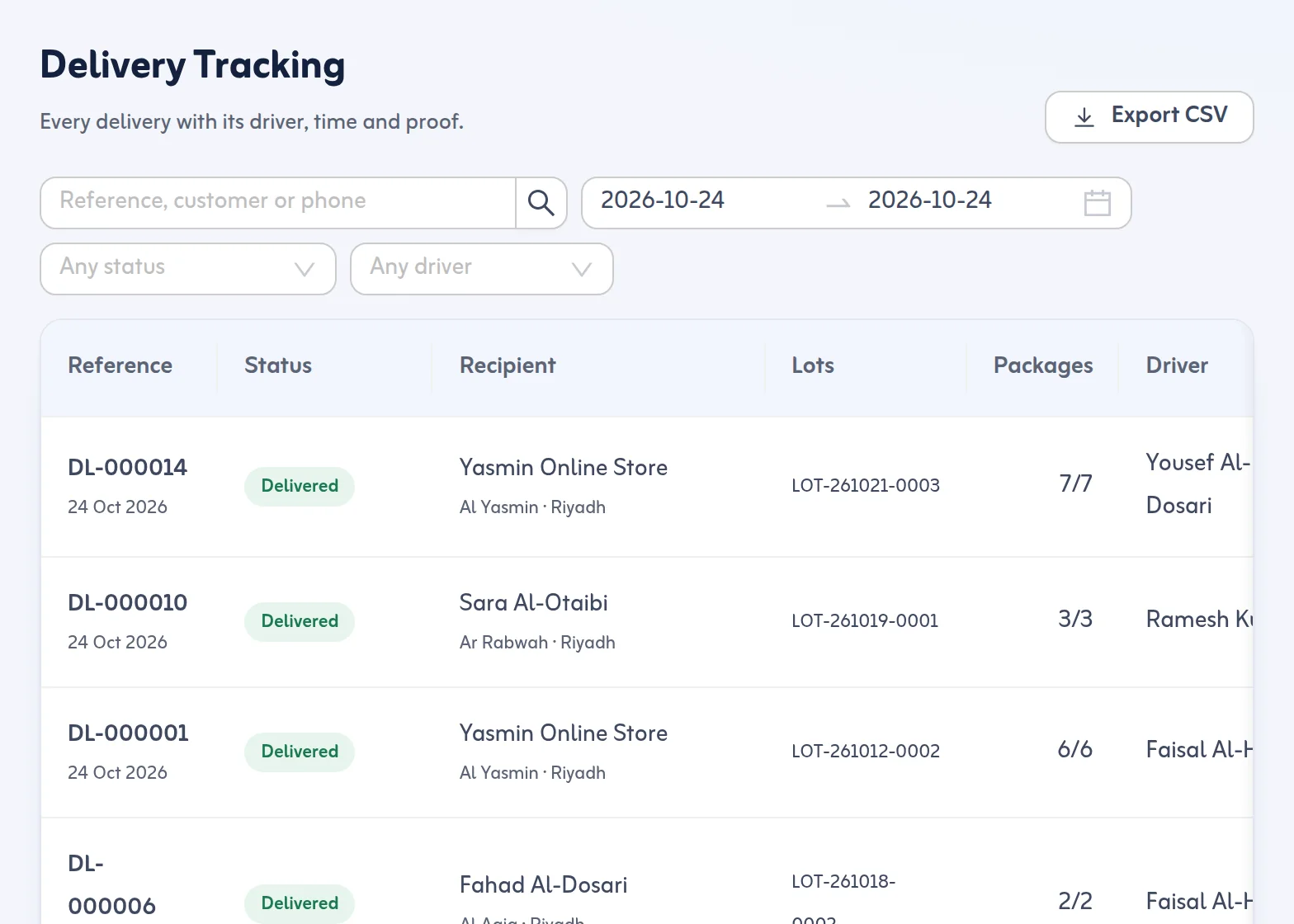
The office can see the proof for every delivery in Delivery Tracking. See proof of delivery, delivery tracking, the driver app help and the Tafsee Logistics overview. Plans and the 14-day trial are on the pricing page.
Questions
Frequently asked questions
POD stands for proof of delivery: a record showing goods were handed to the right recipient at the right place and time.
Neither is best for every case. A code is fast and only the customer knows it. A signature is familiar and works when the customer cannot find the code. Many businesses allow both.
No. The customer sees the code on their tracking page and in the on-the-way email. The office can read it from the lot page if the customer calls.
After 5 wrong codes, the code is locked and the app asks for the customer's signature instead.
More articles
Receive your first shipment today
Try everything in Growth free for 14 days, then choose a plan. No card is needed.
- Arabic and English
- Built for Saudi Arabia, in SAR
- Nothing to install

Warehouse & delivery
Tafsee Logistics
Receive goods with a barcode on every package, hold them until they are cleared, then plan delivery trips with proof at every door.