

The Warehouse Receiving Process: Steps, Checks and Common Mistakes
Receiving is where most warehouse errors begin. This step-by-step guide shows what to check at the door, what to record and how to label goods so they can be found later.
Tafsee Team · · 6 min read
Receiving is the first thing a warehouse does with your goods and the step that decides how smooth everything else will be. If a box is counted wrongly at the door, the mistake follows it through storage, dispatch and delivery, and it is usually found when a customer is already waiting. A clear receiving process is cheap to set up and removes a lot of later arguments.
What is the warehouse receiving process?
The receiving process is the set of steps from the moment a truck, container or courier arrives at your door to the moment the goods are recorded, labelled and put in a storage location. Its output is a trustworthy record: whose goods these are, what arrived, in what condition and where they are now.
Step 1: Prepare before the goods arrive
Where possible, know what is coming. A sender may tell you the customer, the number of packages and the expected day. Clear a space, make sure the label printer has paper and that someone is free to count. Receiving in a hurry, with no space to put things, is when errors happen.
Step 2: Check the vehicle and the paperwork
Before unloading, compare the paperwork with what you expected. Depending on how the goods travelled, that may be a container number, a bill of lading, an air waybill, a truck plate or a delivery note. Note the driver's name and the vehicle. If a seal is broken or the packaging is visibly damaged, say so before signing anything.
Step 3: Count and inspect
Count the packages, not the pallets, and compare with the paperwork. Look at each for obvious damage, wet cartons, crushed corners or missing labels. Take photos of anything unusual while the goods are still on the truck or on the floor. Photos taken at the door are the best evidence if someone later claims damage happened in your warehouse.
Step 4: Record the arrival
Record the arrival at once, not at the end of the day. At minimum, record who sent it, who owns the goods, how it arrived, how many packages came and which warehouse received them. Add the references you have: container number, bill of lading, air waybill, weight, volume and a short description.
Some references have a known format. A shipping container number, for example, is four letters followed by seven digits under ISO 6346, so a typing mistake can be caught immediately. A system should warn about a wrong format rather than block you, because paperwork is sometimes imperfect and the goods are already at your door.
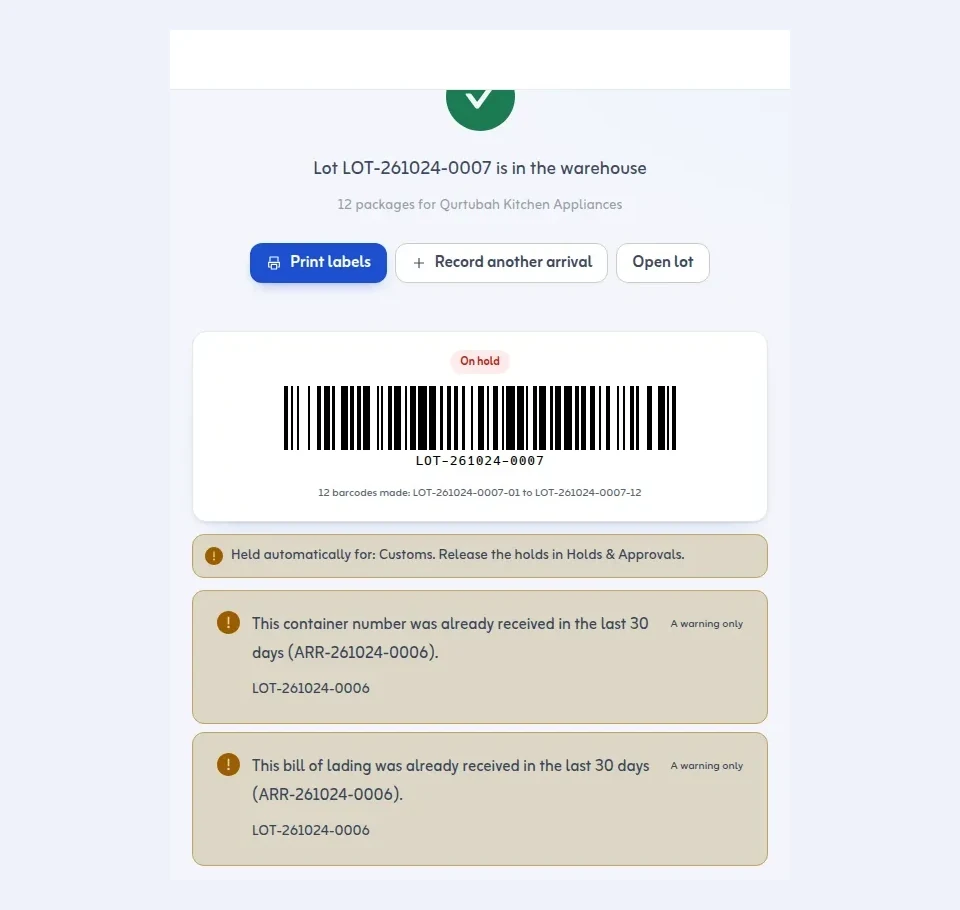
Also look for duplicates. The same container or bill of lading recorded twice in a month is often a double entry, and it is much easier to catch at the door than in the reports.
Step 5: Identify every package
Give each package its own identity. A single lot number for forty boxes tells you little when one box is missing. A barcode label on every package lets you scan it when it is stored, moved, loaded and delivered. Use a clear numbering scheme that includes the date and a sequence, so numbers are never reused.
Print labels straight after recording, and stick them on the side that will face the aisle. Use labels that scanners can read: good contrast, no wrinkles, no tape over the bars. See barcodes and labels for how this works in Tafsee Logistics.
Step 6: Decide if the goods can go straight into stock
Not every arrival is ready to be stored and released. Some wait for customs clearance, for documents or for a manager to approve. Record this on arrival with a reason, so staff do not dispatch goods that should not leave. Holds and approvals explains the idea in more detail.
Step 7: Put away and record the location
Move the goods to their rack or zone and record the location. The most common cause of a lost lot is a lot that was put on a shelf and never written down. Scanning the rack code and the package barcode together is the most reliable way, because it takes a second and cannot be mistyped.
Common receiving mistakes
- Counting pallets instead of packages. The paperwork says forty boxes; the pallet says one.
- Recording at the end of the day. Details are forgotten and goods sit unrecorded.
- No photos of damage. Without them you cannot show the condition on arrival.
- Requiring a field you often do not have. If staff must type a container number for a walk-in drop-off, they type nonsense. Make only the essential fields required.
- One label for many packages. You cannot scan a single package later.
- No owner recorded. Goods without a named customer are the hardest to deliver.
- Forgetting the location. Put-away is part of receiving.
A simple receiving checklist
- Space cleared and labels ready.
- Paperwork matches the delivery.
- Packages counted one by one.
- Damage photographed.
- Arrival recorded with sender, owner and warehouse.
- Barcode label on each package.
- Hold or approval set if needed.
- Rack recorded.
For the delivery side that follows, read about what is last mile delivery.
How Tafsee Logistics handles receiving
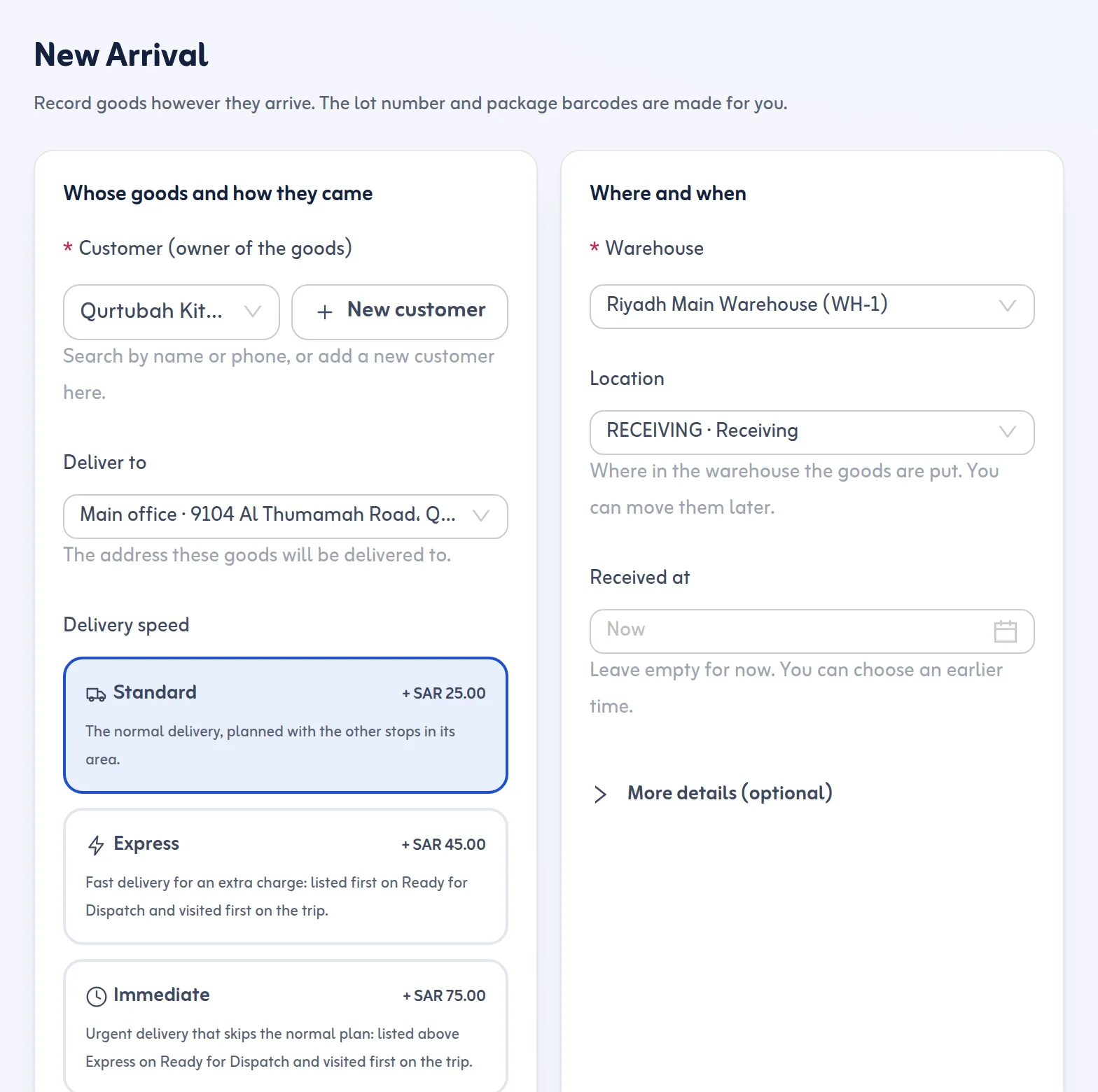
In Tafsee Logistics, New Arrival asks for the sender, the customer who owns the goods, how the goods arrived, the number of packages and the warehouse. Container number, bill of lading, air waybill, truck details, weight, volume, up to five photos and a rack are optional, and a container number is never required. The app warns if the same container or bill of lading was received in the last 30 days.
On saving, it creates the lot number and one Code 128 barcode per package, ready to print on an A4 sheet or 100 × 50 mm thermal labels. See the New Arrival feature, the step-by-step help article, or the Tafsee Logistics page. You can try it with the 14-day trial.
The container unloading process, step by step
- Check the seal number against the bill of lading before breaking it, and photograph it.
- Unload by customer and by marks, not in whatever order the boxes come out.
- Count packages as they come off and compare with the paperwork; note shortages and damage at once.
- Record the arrival with the container number, then print the labels and the goods received note.
- Put each lot on its rack and close the receiving with signatures.
Questions
Frequently asked questions
Preparing before the goods arrive: knowing what is expected, clearing space and having labels ready. Then compare the paperwork with the delivery before unloading.
It is the most reliable approach. With one barcode per package you can scan each one when it is stored, moved, loaded and delivered, and you can see exactly which one is missing.
No. Many arrivals are trucks, couriers or walk-in drop-offs with no container. In Tafsee Logistics the container number is optional, and a different format only shows a warning.
Photos show the condition of the goods when they arrived. If damage is claimed later, they help show whether it happened before or after the goods reached you.
More articles
Receive your first shipment today
Try everything in Growth free for 14 days, then choose a plan. No card is needed.
- Arabic and English
- Built for Saudi Arabia, in SAR
- Nothing to install

Warehouse & delivery
Tafsee Logistics
Receive goods with a barcode on every package, hold them until they are cleared, then plan delivery trips with proof at every door.