

Cash on Delivery in Saudi Arabia: How to Collect and Reconcile It
Cash on delivery puts money in drivers' hands. This guide covers how to set amounts, collect at the door, count at the end of the day and handle differences.
Tafsee Team · · 6 min read
In Saudi Arabia many customers still prefer to pay when the goods reach their door. For a delivery business this is convenient for the customer and risky for the company: cash is now travelling in a van, handled by several people, and the books only balance if every riyal can be traced. This guide covers a simple, repeatable way to run cash on delivery, often shortened to COD.
What is cash on delivery?
Cash on delivery means the customer pays for the goods, or for the delivery, when they receive them. The driver collects the money, hands it to the office and the office passes it to the seller or keeps the delivery charge. COD adds three jobs to every delivery: knowing how much to collect, recording what was actually collected and reconciling it at the end of the day.
The risks of COD
- Wrong amount quoted. The driver and the customer disagree about what is owed.
- Cash not recorded. Money is collected but nobody writes it down.
- Differences at handover. The driver hands in less than expected and nobody can say when the difference appeared.
- Failed deliveries. If the goods come back, the cash must not appear.
- Partial deliveries. Some packages are accepted and some refused, so the amount changes.
- Late settlement. Cash that sits in a driver's pocket overnight is a risk for everyone.
A simple COD routine
Before the trip: set the amount per stop
Decide how much each stop must collect before the van leaves, and write it on the trip sheet and in the driver's list. A driver should not need to calculate or phone the office at the door.
At the door: collect and record
The driver hands over the goods, collects the amount and records it straight away. If the customer pays a different amount, for example because a package was refused, the driver records the actual amount and explains why. A note is much better than an unexplained number.
After the trip: count and compare
At the end of the trip, the office counts the cash and compares it with what the system expected for that driver and that trip. Do it face to face, the same day. If there is a difference, record it with a note: who, how much and the probable reason.
Keep the history
Each handover should be recorded with who handed over, who received it, the date and time and the amount. The record is what lets you answer a question months later.
COD and delivery charges
COD can mean two things: collecting the price of the goods for a seller, or collecting your own delivery charge. Keep them separate in your records. If your business charges per delivery stop with different speeds of service, decide whether the driver collects that charge at the door or the customer pays it elsewhere, and record which one applies.
COD and returns
If a delivery fails or only part of it is accepted, the expected cash changes. The system should reflect this, so that the driver is not asked to hand in cash that was never collected. Returned goods should be checked back into the warehouse by scan. See how to reduce failed deliveries.
Tips for fewer COD problems
- Tell the customer the amount in advance so there are no surprises and they have the right cash ready.
- Collect proof of delivery as well. Cash and proof together protect the driver. See what is proof of delivery.
- Count the same day. Every day of delay makes differences harder to trace.
- Require a note for every difference.
- Limit who can record handovers to trusted office staff.
- Review drivers' patterns over time rather than reacting to one small difference.
Common COD mistakes
- Mixing the seller's money with your delivery charge. Keep the two in separate columns, or you will not know what to pay out.
- Handing the driver loose cash for change without a record. Change given at the door changes the amounts.
- Counting cash only when a driver complains. Count after every trip.
- Leaving differences 'for later'. An unexplained difference that is a day old is already hard to trace.
- Letting one person collect, count and record. Separate at least the counting from the collecting.
A worked example
These numbers are made up to show the method. A driver leaves with five stops that must collect 150, 80, 220, 0 (already paid) and 95 riyals, so the expected cash is 545 riyals. At the second stop the customer refuses one package, and the driver records 60 riyals collected instead of 80, with a note. At the fifth stop nobody is home, so the stop fails and 0 is collected. When the driver returns, the office counts the cash and compares it with the amounts recorded for the stops that were completed: 150 + 60 + 220 = 430 riyals. If the cash counted is 430, the books agree. If it is 410, the 20 riyal difference is recorded with a note the same evening, while the driver remembers the day.
Questions to settle before you offer COD
- Who is allowed to collect cash, and who is allowed to count it?
- How late can a driver hand in cash, and what happens when they cannot?
- Do you accept only cash, or other methods? Record the method you actually used.
- What happens to the money for a package that comes back?
- How long do you keep handover records, and who can see them?
Safety and trust
Cash on delivery makes drivers a target and a suspect at the same time. Clear routines protect them: a visible amount per stop, a photo or signature as proof, a same-day count and a note for every difference. Good records are fair to honest drivers and make careless or dishonest behaviour visible early.
How Tafsee Logistics handles cash on delivery
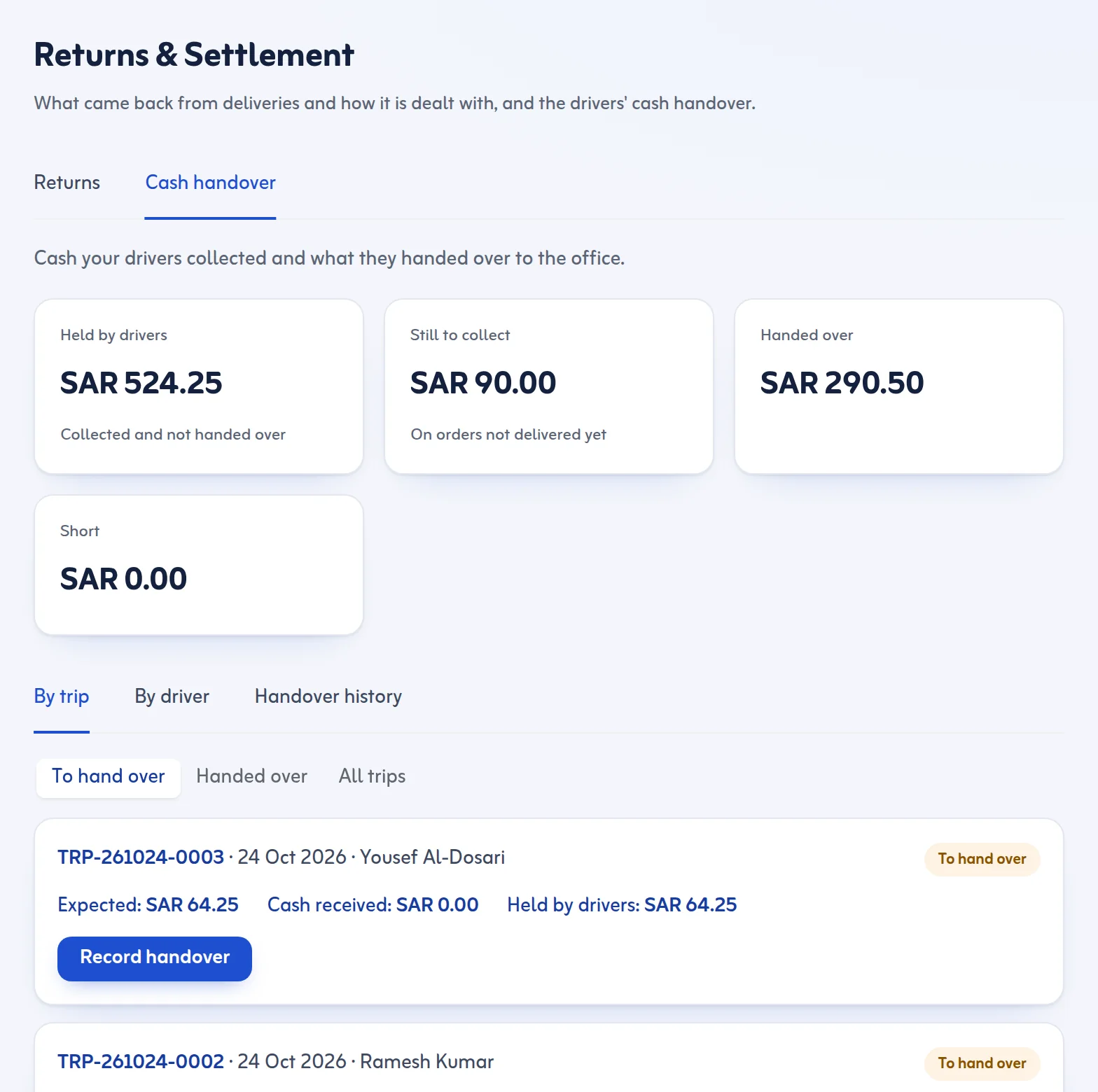
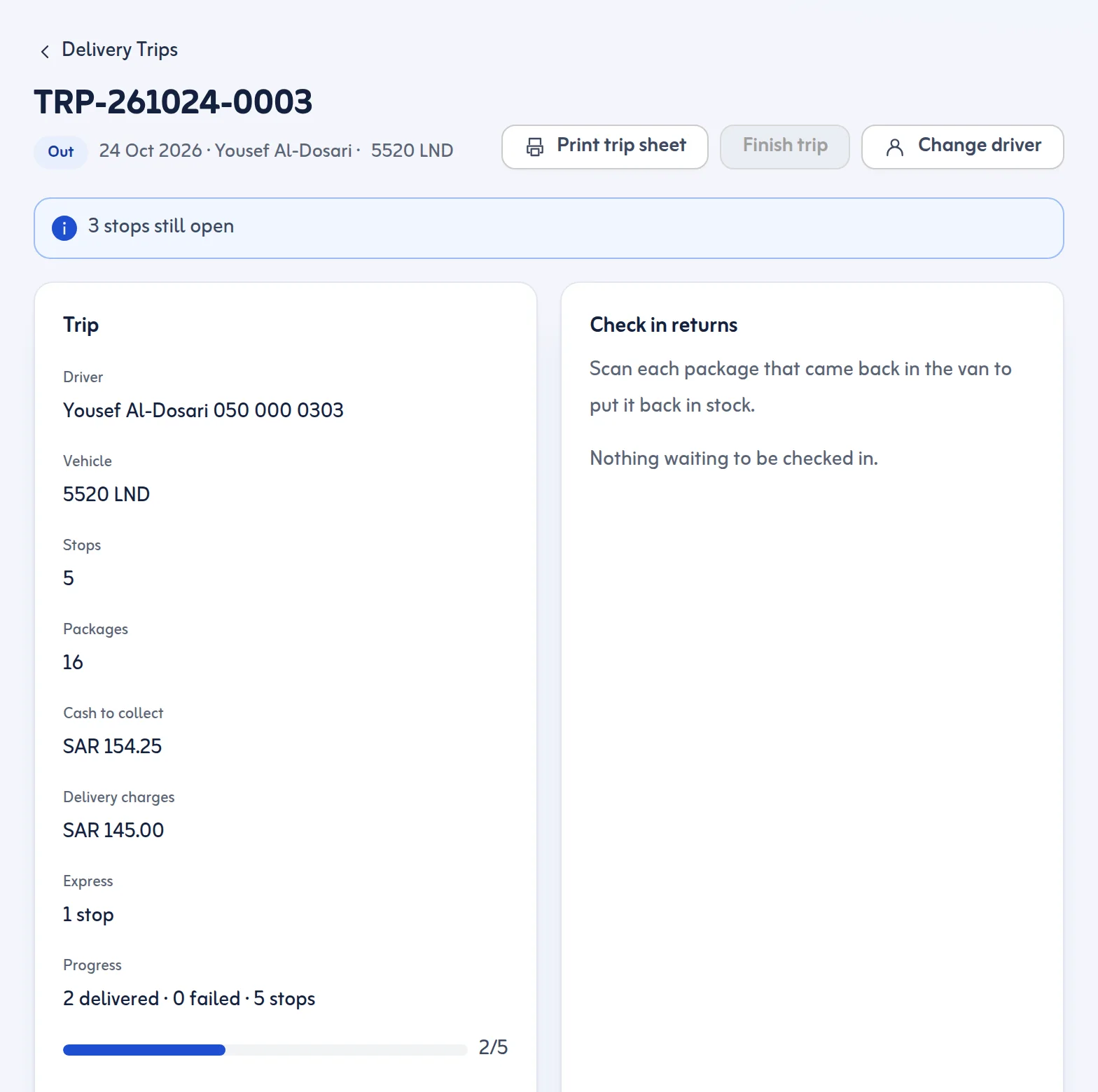
In Tafsee Logistics you set the cash to collect for each stop before the trip starts. The driver records the cash collected in the driver app; an amount different from the expected one needs a note. After the trip, the Cash handover tab in Returns & Settlement shows the expected cash for each driver and trip against the cash counted, a difference needs a note, and the handover is recorded with who and when.
Delivery services such as Standard and Express can carry a charge per delivery stop, and the driver can optionally collect that charge in cash at the door. Cash handover per driver is available on the Starter plan and above. See the cash on delivery feature, the handover help article and the plans. You can also read about last mile delivery.
In short, cash on delivery: Saudi Arabia's shoppers still choose it often, so the cash side of delivery deserves the same care as the parcels.
Questions
Frequently asked questions
It is a payment method where the customer pays for the goods, or the delivery, in cash when they receive them. The driver collects it and hands it to the office.
After every trip, on the same day. Differences are far easier to trace when the trip is fresh.
The driver should record the actual amount with a note explaining why. In Tafsee Logistics a different amount needs a note.
Tafsee Logistics records cash on delivery and the handover. It is not a payment gateway.
More articles
Receive your first shipment today
Try everything in Growth free for 14 days, then choose a plan. No card is needed.
- Arabic and English
- Built for Saudi Arabia, in SAR
- Nothing to install

Warehouse & delivery
Tafsee Logistics
Receive goods with a barcode on every package, hold them until they are cleared, then plan delivery trips with proof at every door.