

What Is Last Mile Delivery? Meaning, Challenges and How to Run It Well
The last mile is the final leg that takes goods from a warehouse to the customer's door. Here is what it involves, why it is hard and the habits that make it work.
Tafsee Team · · 5 min read
A pallet can travel across an ocean and through several warehouses without much drama, and then fail in the last few kilometres: a wrong address, nobody home, a van that is too full, a driver who cannot find the entrance. That final leg is called last mile delivery, and for many businesses it is where most problems and most customer complaints come from.
What is last mile delivery?
Last mile delivery is the last step of moving goods: from a warehouse, depot or store to the place where the customer receives them, usually a home, a shop or an office. Despite the name, it is not literally one mile. It can be a few streets or a whole city. What defines it is that it ends with a person receiving a package at an address.
It is different from the earlier legs. Moving a container from a port to a warehouse is a few large movements. The last mile is many small ones: lots of stops, lots of addresses, lots of different customers, and a person who has to be there or has to be reachable.
Why is the last mile hard?
- Many stops, little time. One driver may serve many customers in a day, and every stop has its own delay.
- Addresses are imperfect. A district name and a street may not be enough to find a building. See the National Address for delivery.
- Customers are not always there. A missed delivery means another trip. See how to reduce failed deliveries.
- Vehicles have limits. A van can carry only so many packages, kilograms and cubic metres.
- Cash is involved. Many deliveries are paid at the door. See cash on delivery in Saudi Arabia.
- Proof matters. When a customer says the package never came, you need something better than the driver's word. See what is proof of delivery.
- Little visibility. Once the van leaves, the office often knows nothing until someone calls.
The main parts of last mile delivery
Getting goods ready
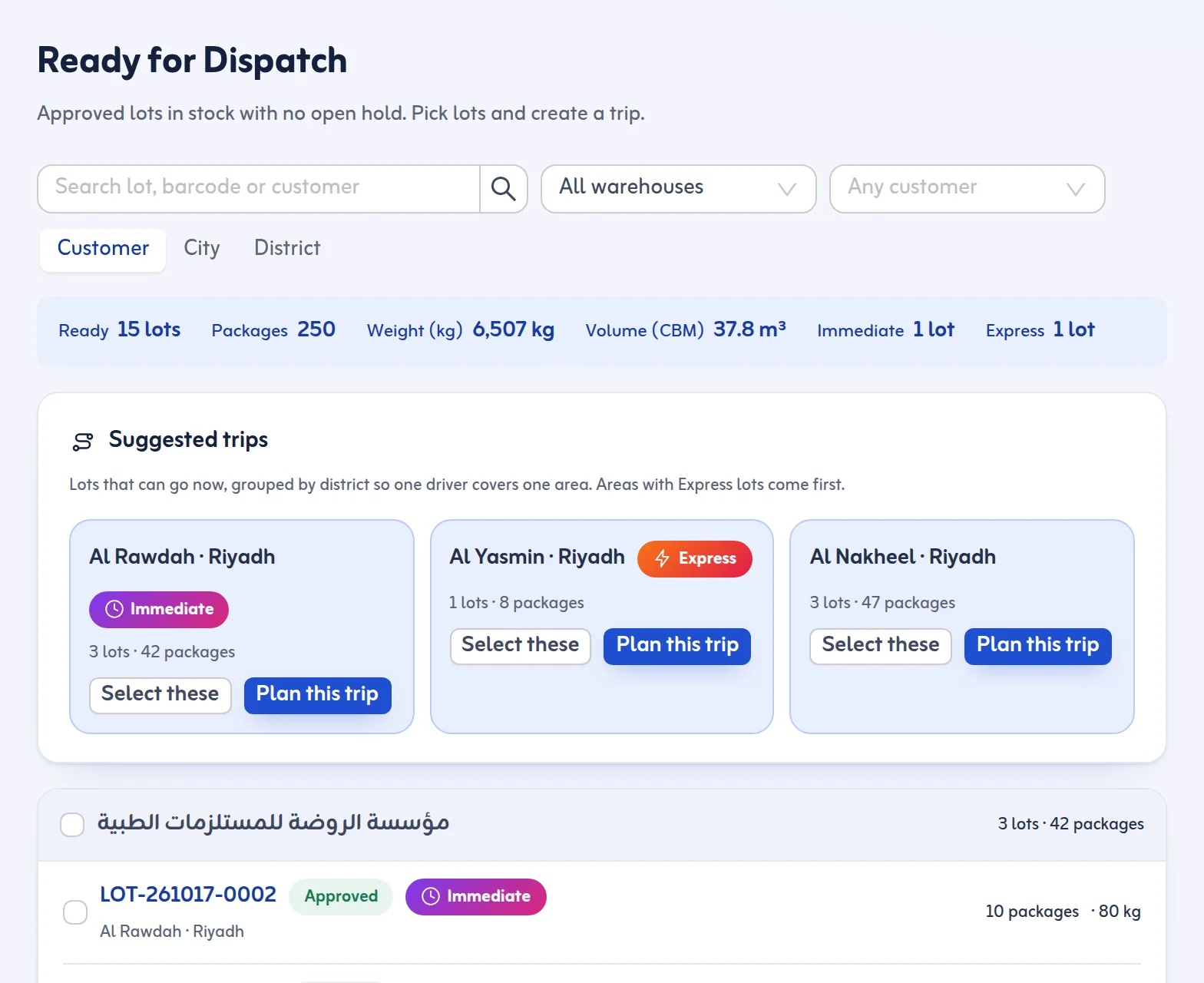
Only goods that are complete, approved and not on hold should go out. Sending something that is not cleared causes a failed stop that was avoidable. The better your warehouse record, the fewer surprises.
Grouping and planning
Goods are grouped by area so that one driver covers one district, then turned into a trip: a date, a driver, a vehicle and an ordered list of stops. A good plan keeps drivers from crossing the city twice and keeps urgent deliveries first.
Loading and handover
Each package should be checked onto the van, so that nothing is forgotten and nothing is taken that should not be. The moment the driver takes the boxes is the moment responsibility moves to the driver, so it should be recorded.
Delivering
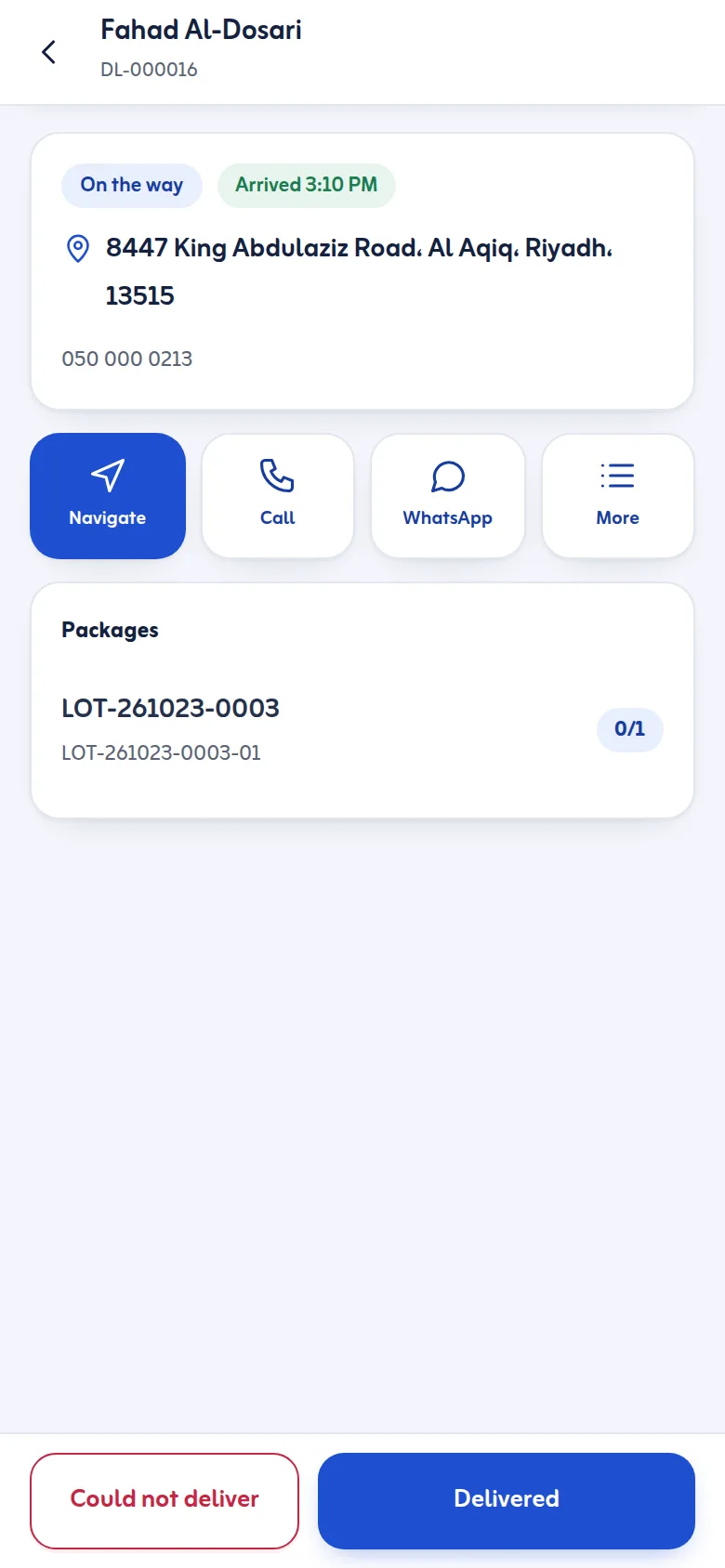
At each stop, the driver finds the address, contacts the customer if needed, hands over the packages and collects proof, and cash if it is owed. If the delivery cannot be completed, the driver records the reason in plain words.
Closing the trip
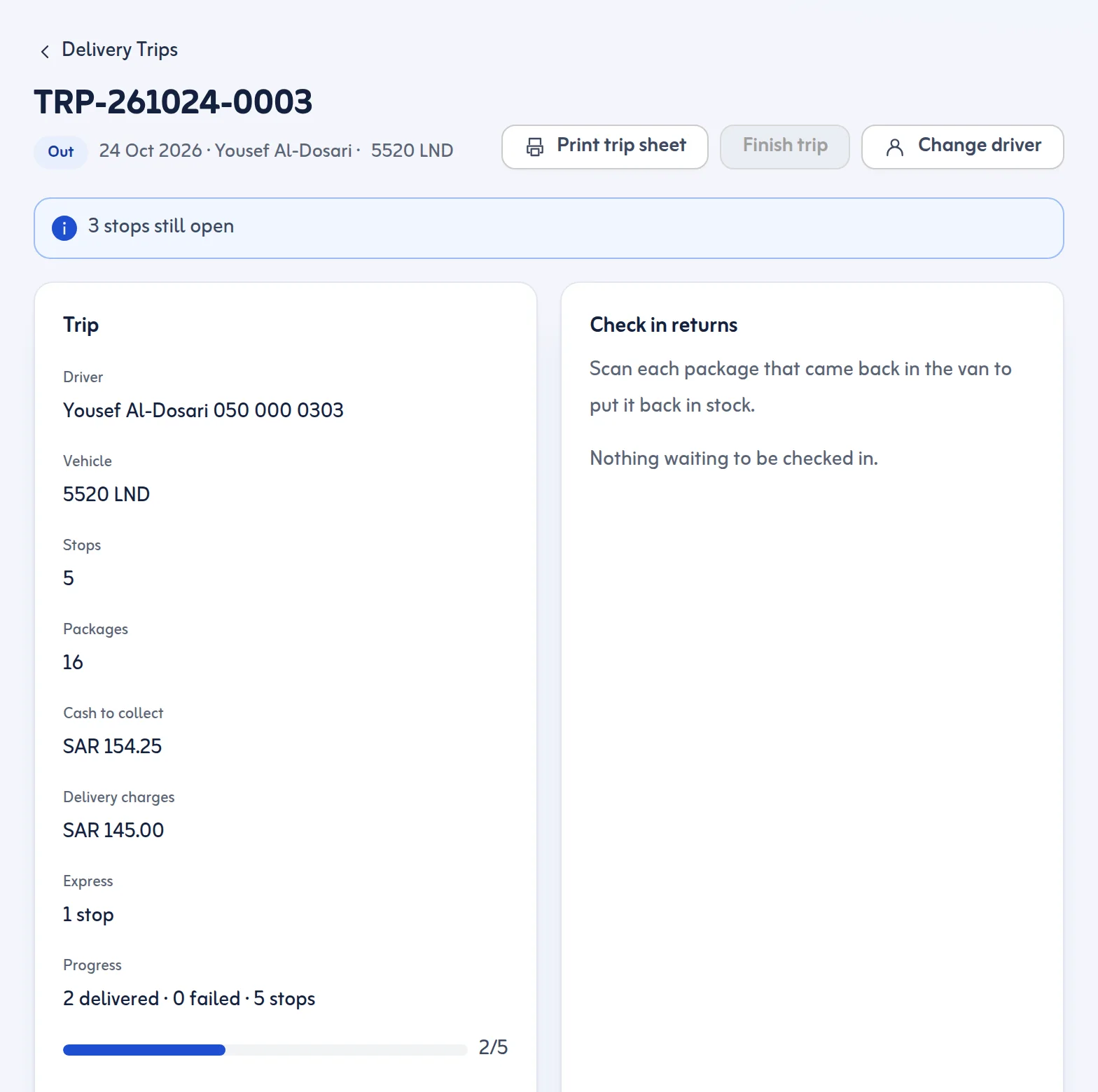
At the end of the day, every package needs an outcome: delivered, partly delivered, failed or returned to the warehouse. Cash collected must be handed in and checked against what was expected.
Handling the exceptions
Failed and partly delivered stops are not the end of the story. They need a next step: try again, return to stock or return to the sender, each with a note.
Habits that make the last mile work
- Capture clean customer data. A phone number and a precise location save phone calls. A map pin is often more reliable than a description.
- Group by district. Short trips beat long ones.
- Check capacity before the van leaves. An overloaded van is slow and risky.
- Scan packages onto the vehicle so you know what is on board.
- Record proof every time, not only when you think there may be a dispute.
- Tell customers what to expect. A tracking link with a clear status saves calls.
- Review failures by reason. If most failures are wrong addresses, fix address collection, not drivers.
- Count the cash every trip. Small differences are easier to explain the same day.
What to look for in last mile delivery software
The software should follow your real process: from a warehouse list of ready goods, to a trip, to a driver's phone, to a recorded outcome. Check that drivers can use it on an ordinary phone, that screens work in Arabic and English, that it records proof of delivery, handles cash on delivery and shows failed stops in one place. Beware of anything that needs special hardware for every driver.
How Tafsee Logistics handles the last mile
Tafsee Logistics starts the last mile from the warehouse record. Ready for Dispatch lists approved lots with no hold and suggests trips grouped by district. A delivery trip has a date, a driver, a vehicle and stops, with a check against the vehicle's capacity in packages, kilograms and cubic metres. Packages are scanned onto the van, the driver accepts them in the driver app on a phone, and each stop is finished with a code or signature and an optional photo.
Failed and partly delivered stops move to Returns & Settlement, and cash is checked per driver and trip. The customer gets a tracking page with the delivery status; while the order is on the way it shows the expected arrival time and how many stops come before theirs, and the driver as a dot on a map when the driver's phone has shared its location in the last 30 minutes. This is not continuous GPS fleet tracking. See software for couriers, the Tafsee Logistics overview or the 14-day trial.
Questions
Frequently asked questions
No. It is the name for the final leg from the warehouse to the customer's door, whatever its length.
It has many small stops, imperfect addresses, customers who may not be at home, vehicle limits, cash to collect and proof to record.
Partly. While the order is on the way, the customer's tracking page shows the expected arrival time, how many stops come before theirs and, when the driver's phone has shared its location in the last 30 minutes, the driver as a dot on an OpenStreetMap map. It is not continuous GPS fleet tracking.
No. The driver app opens in the phone's browser and can be added to the home screen. It is not an App Store or Play Store app.
More articles
Receive your first shipment today
Try everything in Growth free for 14 days, then choose a plan. No card is needed.
- Arabic and English
- Built for Saudi Arabia, in SAR
- Nothing to install
Warehouse & delivery
Tafsee Logistics
Receive goods with a barcode on every package, hold them until they are cleared, then plan delivery trips with proof at every door.