

Bill of Lading vs Air Waybill: What a Warehouse Needs to Know
What a bill of lading, an air waybill and a waybill are, how they differ, and how to record them so a Saudi warehouse can find any shipment later.
Tafsee Team · · 5 min read
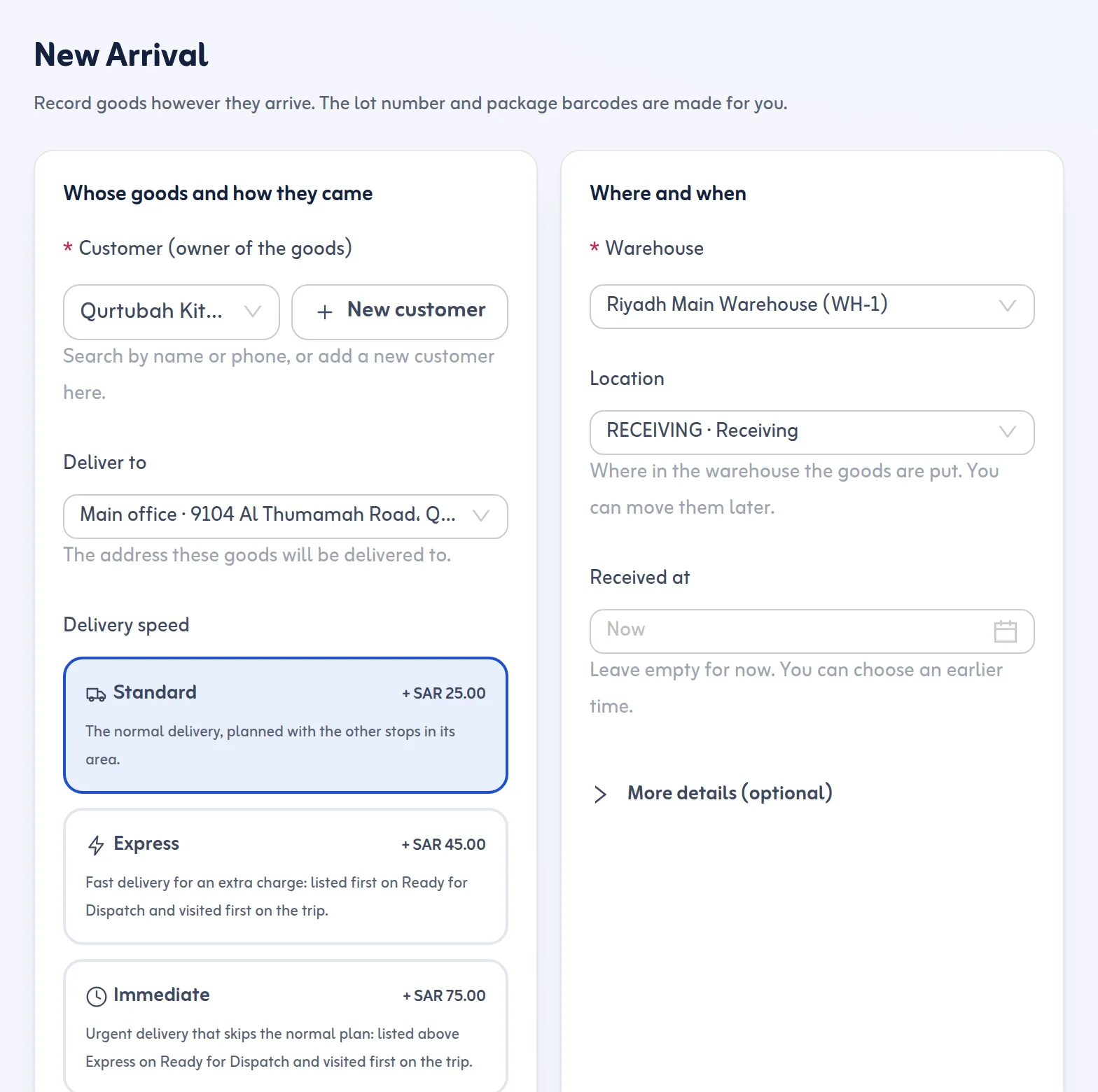
Every shipment that reaches a warehouse arrives with a piece of paper, or a PDF, that says what it is and who it belongs to. At sea it is the bill of lading. In the air it is the air waybill. On the road it is usually a waybill. Warehouse teams meet all three every week, and mixing them up is a quiet source of errors: a number typed in the wrong box, a document that cannot be found when the customer calls. This guide explains the difference and how to record each one.
What is a bill of lading?
A bill of lading, often shortened to B/L, is the document issued by the carrier or its agent for cargo moved by sea. It does three jobs. It is a receipt: the carrier confirms it took the goods. It is evidence of the contract of carriage between the shipper and the carrier. And, in its original negotiable form, it can act as a document of title, which is why who holds the original matters when goods are released. A B/L carries a number, the shipper and consignee, the ports, a description of the goods and the number of packages and containers.
Sea freight into Saudi Arabia is usually arranged through a freight forwarder or shipping agent, so you will often see a house bill of lading issued by the forwarder next to the master bill of lading issued by the shipping line. If you are unsure which number your customer expects you to quote, ask them or the forwarder.
What is an air waybill?
An air waybill, or AWB, is the equivalent for air cargo. It is a receipt and a contract of carriage, but it is not a document of title and it is not negotiable. Its number is eleven digits: a three-digit airline prefix, a serial number and a check digit. The check digit is why a mistyped AWB can often be caught at once. For air cargo Saudi Arabia importers receive, the AWB is the number the airline, the forwarder and the warehouse all use to refer to the same consignment.
And the plain waybill?
A waybill for road transport is mainly a receipt and a record of what the truck carried. It is not a document of title. Many deliveries by truck, including goods brought in from neighbouring countries, come with a waybill or a delivery note, a plate number and a driver name, and that is what your team records.
Side by side
- Bill of lading: sea freight; issued by the carrier or agent; may be negotiable and act as a title document; linked to a container number.
- Air waybill: air freight; eleven-digit number with a check digit; not negotiable.
- Waybill: road or other modes; a receipt and a record; not a title document.
A good freight forwarding partner will explain which documents your goods need. The shipping side, including choosing between sea and air routes, is decided between you and your forwarder or carrier, not by your warehouse software.
How the numbers relate inside Tafsee Logistics
In Tafsee Logistics, one arrival can carry the container number, the bill of lading and the air waybill, and none of them is required. You fill in what the paperwork gives you. The container number is checked as four letters and seven digits; a different format is only a warning and never a block. The AWB gets a check-digit warning too. The system also warns you when the same container number or bill of lading was received in the last 30 days, which catches double entry.
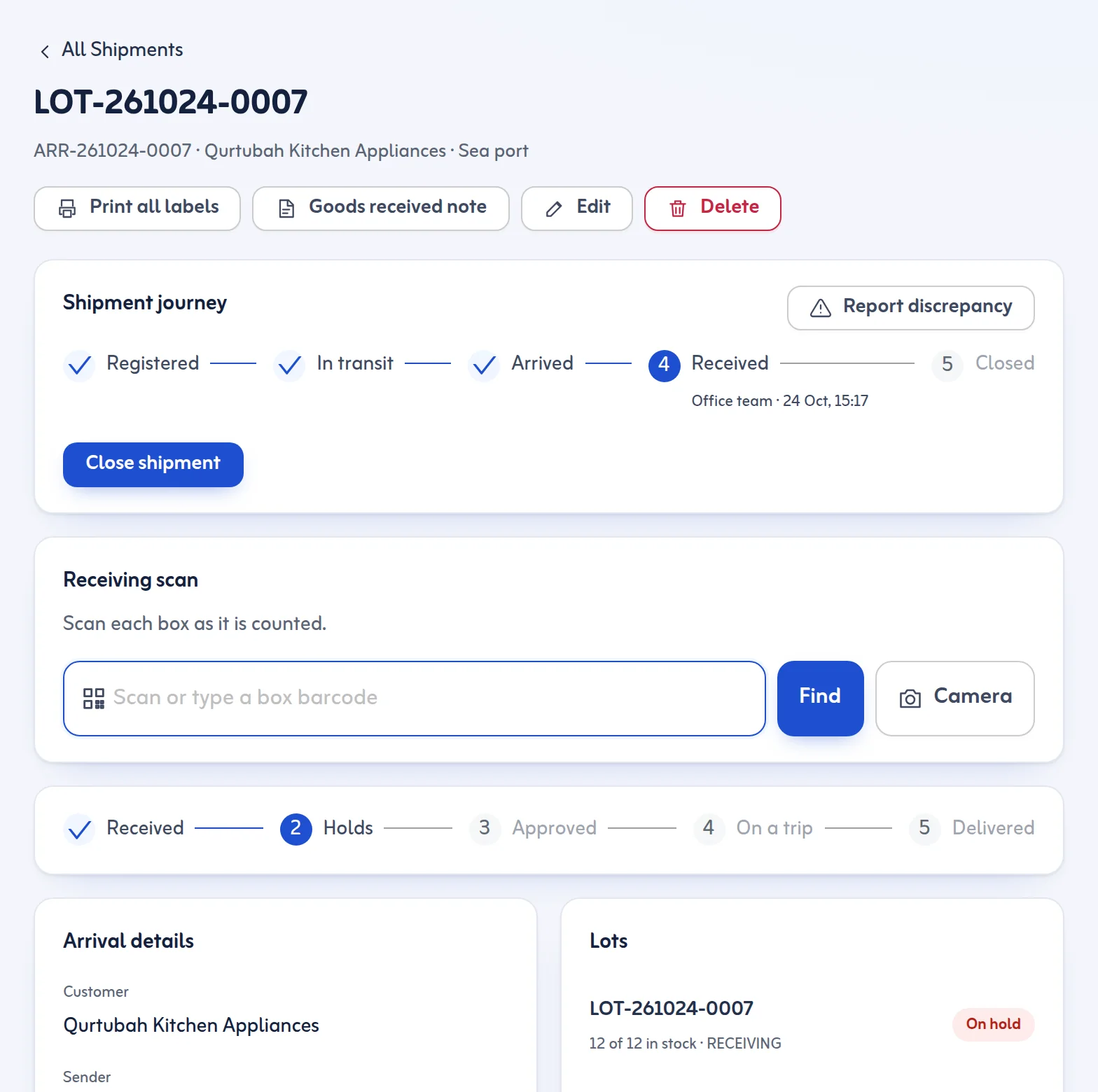
The lot number is different. It is Tafsee's own number, made when you save the arrival: a prefix from Settings, the date and a daily sequence, for example LOT-251021-0001. It is never reused. Each package then gets its own barcode based on the lot number, such as LOT-251021-0001-01. Think of it this way: the B/L, container and AWB are the numbers other people gave your shipment, and the lot number and package barcodes are the numbers your warehouse uses on the floor.
Bill of lading tracking: what you can and cannot do
Let us be honest about bill of lading tracking. Tafsee Logistics does not follow a ship or an aircraft. To see where a vessel is, you use the carrier's or the forwarder's own tracking. What Tafsee does is let you search for any shipment your warehouse recorded by its B/L, container number or AWB, as well as by lot number, barcode or customer. When a customer rings with a B/L number, you find the lot in seconds and see its rack, holds and full timeline.
Two free checkers
Before you type a number into a system, check its shape. Two free tools on this site help: the container number checker and the AWB checker. They test the format and the check digit only; they do not look up the shipment.
Habits that save time
- Record the B/L, container and AWB exactly as printed, without spaces or extra characters.
- Photograph the goods and, if you can, the paperwork on arrival.
- Note the sender or agent, so you know who to call about a discrepancy.
- Treat the number the customer quotes as a search key, not as the lot number.
- Keep customs and document questions as holds on the lot, so they are visible. See FASAH and customs release.
Where to go next
The step-by-step is in record a new arrival, and the idea behind it in the warehouse receiving process. For forwarders, see Tafsee Logistics for freight forwarders and the Tafsee Logistics page.
Questions
Frequently asked questions
No. Tracking a ship or aircraft is done with the carrier or forwarder. In Tafsee you search for shipments your warehouse recorded by bill of lading, container number or AWB.
No. The container number, bill of lading and air waybill are all optional. Only the sender, customer, arrival method, package count and warehouse are required.
No. The lot number is made by Tafsee when you save the arrival and is never reused. The bill of lading number is the one the carrier or agent issued, and you can search by it.
No. The container number checker and the AWB checker only test the format and the check digit of what you type.
More articles
Receive your first shipment today
Try everything in Growth free for 14 days, then choose a plan. No card is needed.
- Arabic and English
- Built for Saudi Arabia, in SAR
- Nothing to install

Warehouse & delivery
Tafsee Logistics
Receive goods with a barcode on every package, hold them until they are cleared, then plan delivery trips with proof at every door.