

FASAH Saudi Customs: What Your Warehouse Does While Goods Wait
A plain explanation of FASAH and Saudi customs clearance, and how a warehouse can keep goods from leaving until someone releases them with a note.
Tafsee Team · · 5 min read
Most delays at a Saudi warehouse do not come from the warehouse. They come from the waiting: the container is on the yard, the paperwork is moving, and the customer is calling every hour. When the goods finally reach your racks, the real risk starts. Somebody sees a pallet, assumes it is cleared, and sends it out. This guide explains FASAH Saudi customs in general terms and shows what a warehouse should do while goods wait for release.
What FASAH is, in plain words
FASAH is the Saudi single window for trade and customs procedures. In general terms, it is the online platform through which the parties to an import or export, such as the importer, the customs broker, the carrier and the authorities, submit and follow the steps a shipment needs before it is released. It is operated by the government, not by warehouses and not by software vendors. Procedures, documents and conditions change, so always confirm the current requirements on the official platform at fasah.sa and with the relevant authority, such as ZATCA, the Saudi Ports Authority or the Saudi Food and Drug Authority when your goods fall under it.
Where the warehouse fits in customs clearance in Saudi Arabia
A customs clearance Saudi Arabia journey has several actors. The importer owns the goods. A licensed customs broker, often a customs clearance company, handles the declaration. The carrier or shipping agent moves the cargo. The warehouse receives, stores and later releases it to the customer. Tafsee is software, so it is none of these: it does not clear goods, and it does not act for you with customs. It helps the warehouse keep its own records straight while the others do their work.
The saudi customs clearance process differs between sea, air and land, and between types of goods. What stays constant for the warehouse is one question: is this lot allowed to leave right now, and who says so?
What a warehouse should do while goods wait for release
Whether you run a bonded warehouse or a general one that stores goods before and after clearance, the same habits protect you.
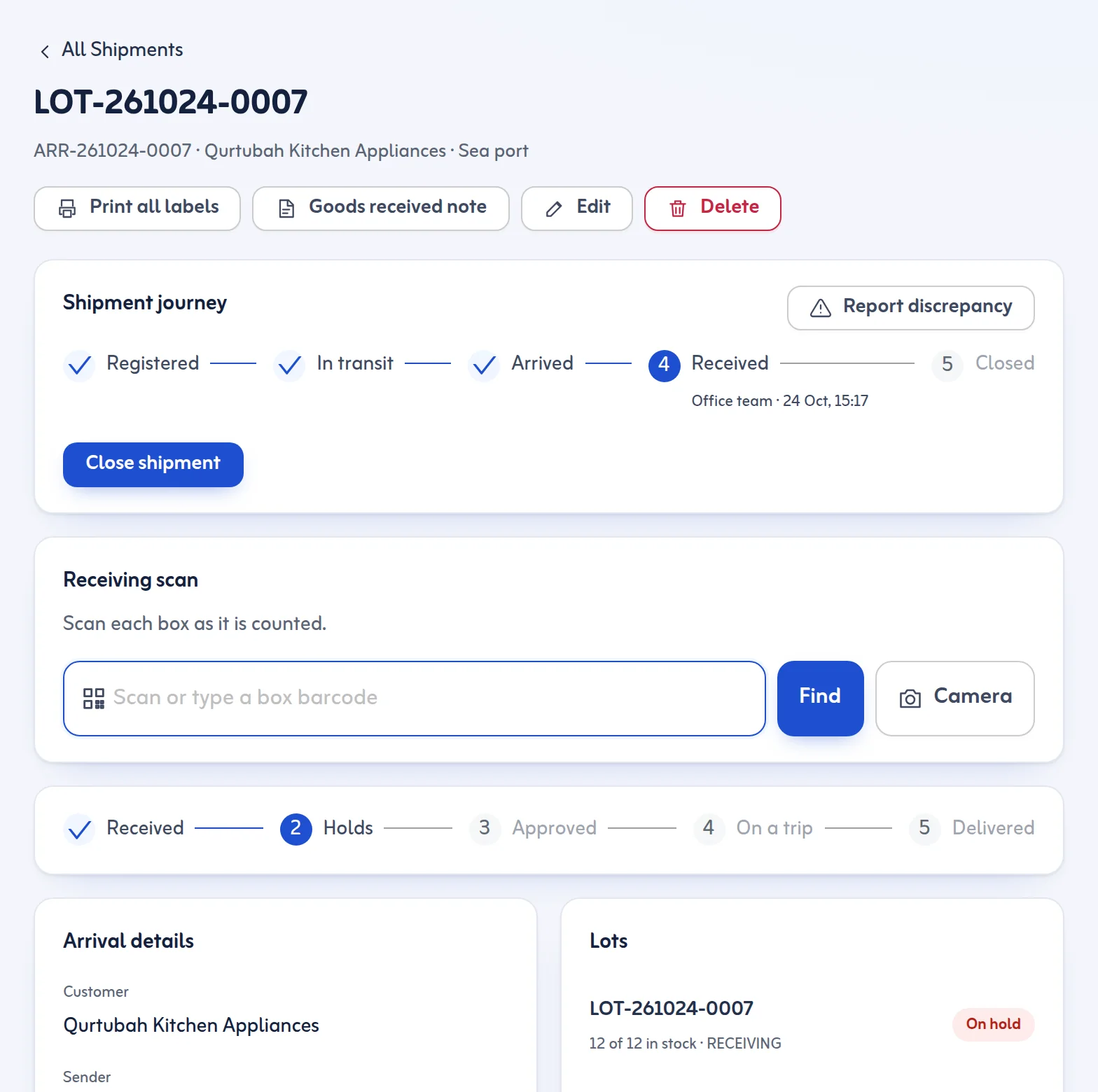
- Record the arrival at once. Container number, bill of lading or air waybill, truck plate, number of packages, photos of the goods. Do it when the goods arrive, not at the end of the day.
- Label every package. A barcode per package means nobody has to guess which box belongs to which consignment.
- Mark the goods as not releasable. A sticker on a pallet is not a control. A system status that blocks dispatch is.
- Keep the documents with the lot. The declaration reference, the broker's contact and any inspection notes should be easy to find from the lot, not in someone's inbox.
- Name who may release. Release should be a decision by a named role, with a note, never a side effect of someone being in a hurry.
- Review old holds. Goods that have waited a long time need a conversation with the owner and the broker, not silence.
How Tafsee Logistics holds a lot until someone releases it
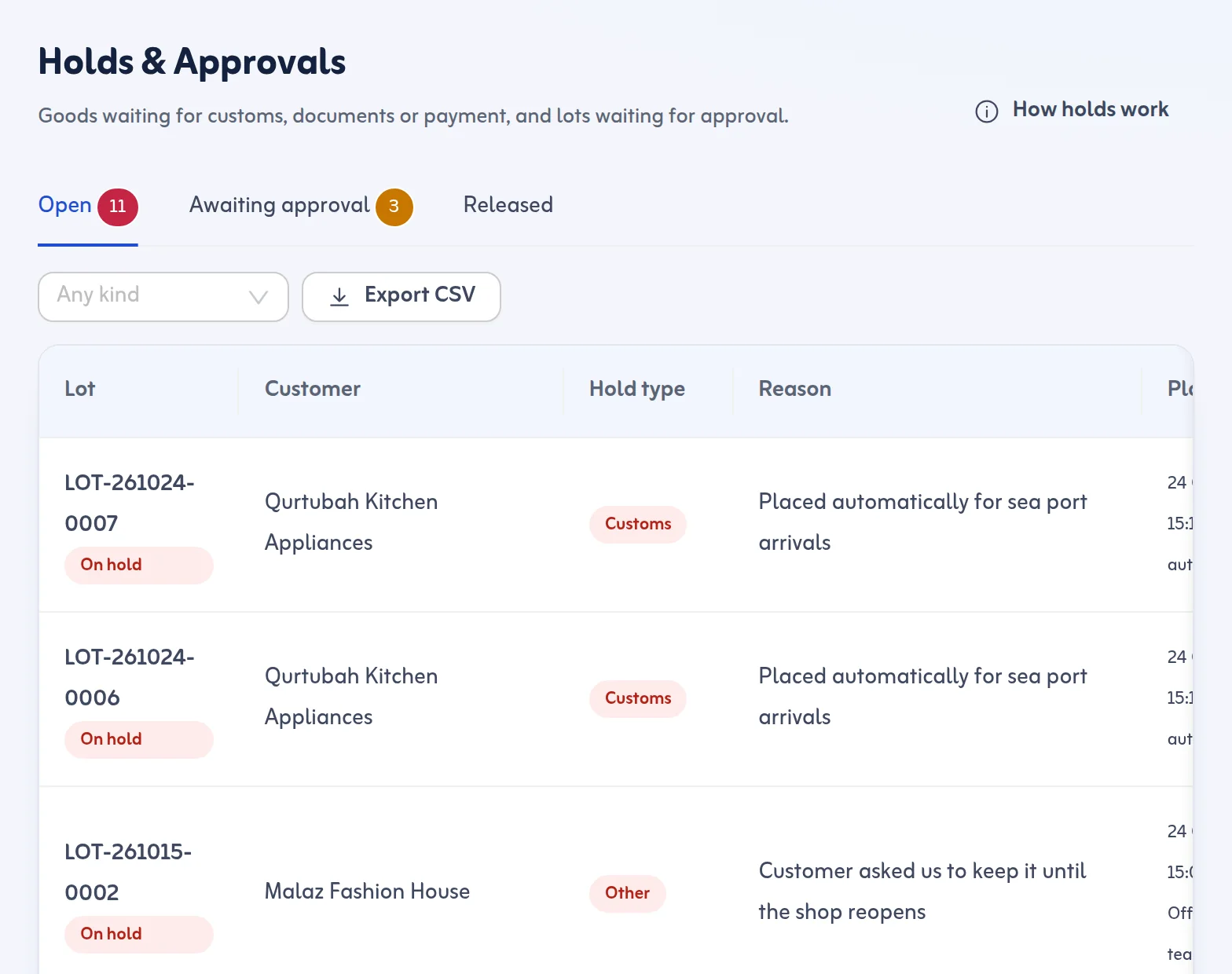
In Tafsee Logistics, you can place a hold on a lot. Hold types are customs, documents, payment, delivery and other, and a reason is required. You can also set an automatic customs hold for arrivals by sea or by air, so every new lot of that kind starts on hold without anyone remembering to add it.
The rule that matters is simple: a lot can be dispatched only when all of its holds are released and it is approved. While a customs hold is open, the lot does not appear in Ready for Dispatch, and trips cannot be built around it. Approval is refused while a hold is open, and a hold placed on an already approved lot takes it back out of Ready for Dispatch.
Releasing a hold needs a note, and the system records who released it and when. Only owners, admins and dispatchers can release. A lot can carry several holds, for example customs and payment, and it moves only when every one is cleared. The Holds & Approvals page has three tabs: Open, Awaiting approval and Released, so the team sees at a glance what is stuck and why.
Be clear about what this is. Tafsee Logistics is not connected to FASAH or to any government system. Your customs broker releases the goods with the authorities. Then someone in your team records that fact in Tafsee by releasing the hold with a note, for example the declaration reference. The software enforces your internal discipline; it does not receive the release from the platform.
Keeping watch on holds
The dashboard shows the number of open holds and a Needs attention list for holds older than the number of days you choose in Settings. The Holds report shows how many holds were placed and released, the average hours on hold and the split by type. That is useful when an owner asks why a consignment took so long, because the history already says who did what.
Questions to ask your customs broker
- What reference should we write on the lot so the release can be traced?
- Which documents does the broker still need from us, if any?
- Will the goods be inspected, and should the packages stay untouched until then?
- Who will tell us the moment the goods are released?
Where to go next
Read how receiving works in the warehouse receiving process, see the holds and approvals feature, or learn the steps in the holds help article. To try it, see the Tafsee Logistics page and the plans with a 14-day trial.
Questions
Frequently asked questions
No. Tafsee Logistics is not connected to FASAH or any government system. Your customs broker deals with the authorities; your team then releases the hold in Tafsee with a note.
No. Tafsee Logistics is software for the warehouse. Customs clearance is done by a licensed customs broker with the authorities.
Only owners, admins and dispatchers. Releasing needs a note, and the system records who released the hold and when.
No. A lot can be dispatched only when every hold is released and it is approved. Until then it does not appear in Ready for Dispatch.
More articles
Receive your first shipment today
Try everything in Growth free for 14 days, then choose a plan. No card is needed.
- Arabic and English
- Built for Saudi Arabia, in SAR
- Nothing to install

Warehouse & delivery
Tafsee Logistics
Receive goods with a barcode on every package, hold them until they are cleared, then plan delivery trips with proof at every door.