
How Saudi Startups Can Automate Their Financial Operations with Smart Accounting Software
Startups often face an enormous operational challenge in managing their finances. In Saudi Arabia, many startups still use spreadsheets, paper invoices, manual bookkeeping and various financial systems that are disconnected from each other to run their business each day. While these practices may work when a startup is first launched, they will ultimately lead to inefficiencies for all businesses as they grow and develop more complicated finance-related activities.
Startups are now expected to perform a variety of different functions simultaneously, including, but not limited to, invoice management, expense management, cash flow management, value-added tax calculations, financial reporting and compliance requirements. Manual handling of any or all of these functions takes tremendous time and can lead to human errors, delays in reporting, and confusion about certain aspects of operations. As Saudi Arabia's government continues to invest in the digital transformation of businesses, startups are increasingly looking at smart accounting software in order to simplify their financial operations and make them more efficient.
Automating financial tasks is no longer limited to large scale businesses. Through the use of cloud-based accounting systems, both startup businesses as well as small and medium-sized enterprises (SMEs) can automate repetitive financial tasks, gain visibility into their business performance and manage their operations from a single point of reference. Companies that adopted automation early are typically better positioned to expand their operations while maintaining high levels of financial control.
The growing adoption of smart receipts software in Saudi Arabia also reflects how businesses are moving toward more efficient and digitally managed financial workflows.
Why Saudi Startups Are Moving Toward Financial Automation
A fast-paced and competitive environment defines how Saudi startups operate. Accurate financial visibility and quick operation serve as keys to achieving long-term growth. Many founders or small management teams have equal responsibility for supporting all aspects of their businesses from customer service, to operations, and finance, billing, and reporting. Unfortunately manual financial processes limit productivity and create bottlenecks in the flow of operations.
Financial automation is becoming a highly sought-after solution for Saudi startups because of the complexities faced when performing daily accounting operations. As transaction volumes increase and so does the difficulty of accurately tracking business expenses using a manual method creating sales invoices from a spreadsheet or maintaining financial records without automation. Small mistakes in calculations or delays in reporting can have a huge impact on budgeting decisions or cash flow management.
Compliance is another issue that has an impact on Saudi startups. Companies operating in Saudi Arabia must have proper financial records, maintain compliant invoicing processes, and follow the ZATCA regulations related to providing sales invoices. Consequently, startups that utilize outdated systems often experience miscoded documents and poor reporting accuracy.
The use of smart accounting software can help alleviate several of these challenges by automating everyday financial activities. Using smart accounting software allows businesses to automatically generate invoices, categorize expenses, monitor payments and create immediate access to up-to-date financial statements or reports without having to rely on all of these activities being performed by hand. Automating these activities will not only cut down on the number of tasks associated with administration but will also increase operating efficiencies and improve visibility into the company's finances.
Consider a growing startup that has been manually managing invoices across departments may be experiencing delayed approvals and missing records, and inconsistent recordkeeping for expenses. By using an automated accounting application, the startup accounts for its operations from one location through a single dashboard, creating simpler workflows and better decisions.
Financial Challenges Most Saudi Startups Face During Growth
Startups largely centre their attention around growing their business during the initial phase of development through sales and customer acquisition. As they are doing this they may fail to adequately develop their financial infrastructure. When the volume of operational activity increases, it often becomes difficult for startups to use manual accounting systems correctly and accurately.
One area that many start-ups find to be particularly challenging is managing their expenses. A common issue within start-ups is the proper organization of suppliers, employee reimbursements, operational expenses and receipts. When a company does not maintain an organised filing system for their financial records, or provide the proper documentation, the company could run into issues during an audit or when filing taxes.
Another challenge for start-ups is managing their cash flow. If they do not have real-time visibility into their incoming revenue and their outgoing operational expense. They may not be able to successfully budget, forecast, or prepare any type of financial plan. A company that is not using integrated tools will not have accurate financial information available for rapid decision-making.
Preparing invoices manually is another example of what creates an operational inefficiency within start-ups. The time it takes to prepare an invoice manually, greatly reduces the efficiency with which the company is able to invoice, it also increases the risk of calculations being made incorrectly, the incorrect amount of VAT being deducted and/or the company potentially having to wait a long time to receive payment from their customers. Each of these issues can have a direct impact on a company's customer relations and collection of revenue.
Inefficiencies are also created by means of manual invoicing. By utilizing this method of preparing invoices, companies may waste valuable hours creating invoices, increase the chances of incurring errors when performing calculations and entering VAT incorrectly, facing longer payment cycles, resulting in an issue with their customers, and ultimately affect their ability to collect revenue.
Compliance management has also become more difficult for all businesses in Saudi Arabia, meaning that start-up companies need to maintain accurate invoices and well-organised financial documentation to demonstrate compliance with VAT reporting obligations and a commitment to operational transparency. Companies using dated accounting methods will tend to encounter challenges in their ability to maintain their ongoing compliance practices.
As the digital business ecosystem in Saudi Arabia continues to grow, so too do the number of start-ups adopting cloud-based financial systems to improve operational effectiveness, decrease manual processing and enable longer-term scalability.
How Smart Accounting Software Improves Financial Operations
Managing financial operations manually becomes increasingly difficult as startups grow. Smart accounting software helps businesses streamline accounting workflows and improve reporting accuracy, and maintain better control over operational finances through automation and centralized management.
Invoice Automation
Modern accounting systems simplify invoice generation by automating billing workflows, VAT calculations, recurring invoices, and payment tracking. This helps businesses reduce manual processing time while improving invoice accuracy and transaction management.
Expense Monitoring and Cost Control
Automated expense management allows businesses to track operational spending more efficiently. Digital receipt management, expense categorization and real-time expense monitoring help startups maintain organized financial records and improve budgeting control.
Centralized Financial Management
Cloud-based accounting platforms allow startups to manage invoicing, accounting, expenses, reporting, and financial workflows from one centralized dashboard. This improves operational coordination and reduces dependency on disconnected systems.
Real-Time Reporting and Analytics
Advanced reporting tools provide businesses with instant access to financial insights, operational summaries, profit analysis, and cash flow monitoring. Real-time analytics help startups make faster and more informed financial decisions.
Multi-Platform Integration
Smart accounting software can integrate with payment gateways, POS systems, banking platforms, and operational tools. Connected financial systems improve workflow efficiency and reduce repetitive administrative work.
Remote Accessibility and Data Security
Cloud accounting platforms allow businesses to securely access financial information from multiple locations and devices. This flexibility supports remote operations while maintaining data protection and operational continuity.
Key Features Saudi Startups Should Consider in Accounting Software
Choosing the right accounting software is important because not every platform is designed for the operational requirements of Saudi businesses. Startups should focus on systems that support automation, compliance, scalability and centralized financial management.
Automated Invoicing
Invoice management plays a major role in daily business operations. A reliable accounting system should simplify invoice creation while supporting accurate VAT calculations, organized documentation and faster billing processes.
Expense Tracking and Receipt Management
Managing operational expenses manually often creates reporting inconsistencies and budgeting challenges. Smart accounting systems help businesses digitize receipts, categorize expenses automatically and improve financial visibility through centralized expense management.
Cloud-Based Accessibility
Startups managing remote operations or multiple teams require secure and flexible access to financial information. Cloud accounting platforms allow businesses to manage financial operations from anywhere while improving collaboration between departments.
Integration with Business Tools
Modern accounting software should integrate smoothly with payment gateways and POS systems, invoicing platforms, and operational tools. Connected systems help businesses simplify workflows and reduce manual administrative effort.
Reporting and Financial Dashboards
Real-time reporting features provide better visibility into operational performance, profitability, expenses, and cash flow management. Centralized dashboards help startups make faster and more informed financial decisions.
ZATCA Compliance Support
Compliance management remains an important requirement for businesses operating in Saudi Arabia. Accounting software should support VAT-ready invoicing, financial record management, and reporting processes aligned with ZATCA requirements. As VAT regulations and financial reporting standards continue evolving, many businesses are also focusing on improving their understanding of taxation processes, compliance management, and VAT requirements for Saudi businesses across daily financial operations.
How Tafsee Supports Saudi Startups with Financial Automation
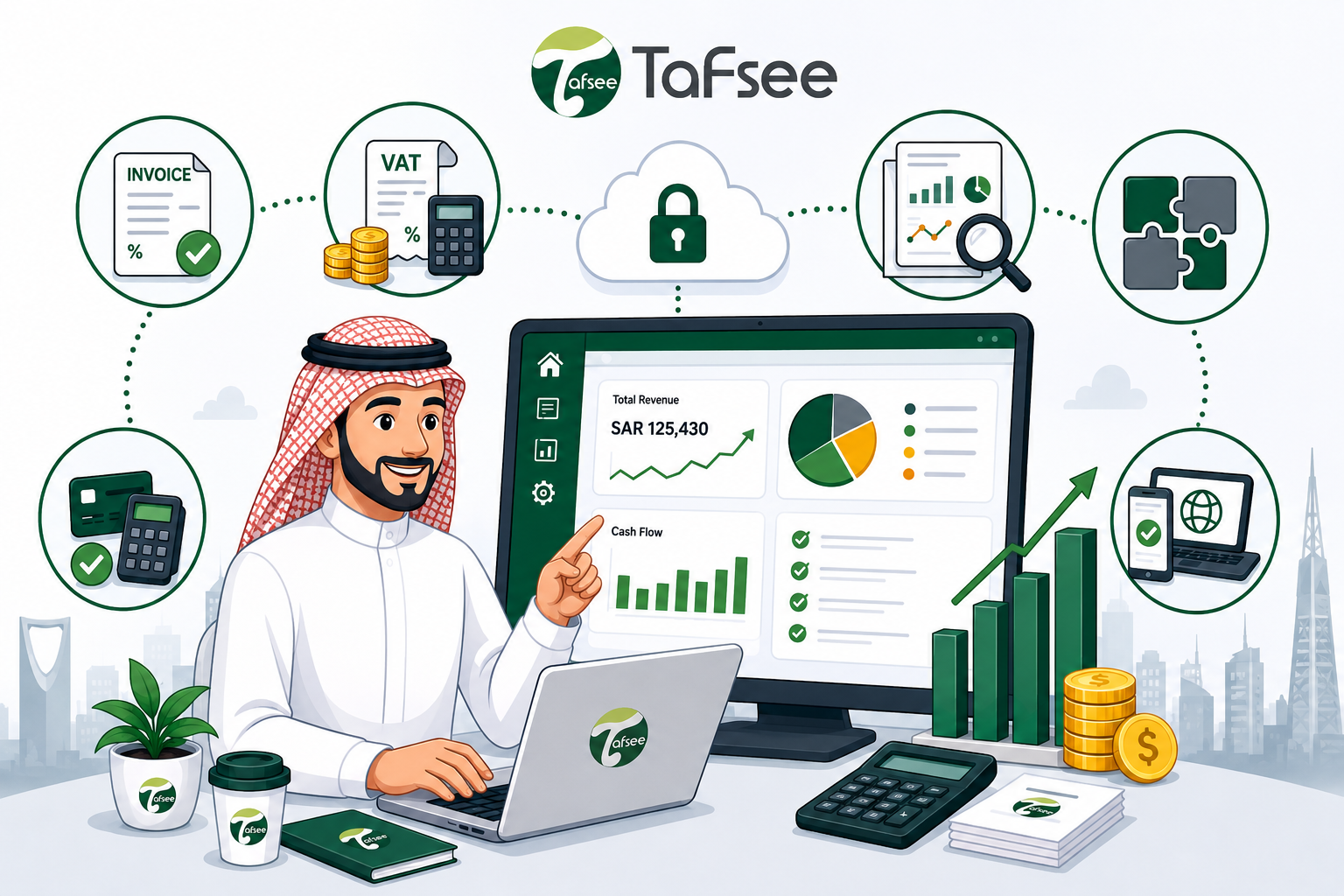
Tafsee was built for the purpose of making it easier for businesses in Saudi Arabia to organize their accounting processes and control their finances using automation. By using one centralized platform rather than several different and disconnected systems, startups can use invoices, expense tracking, reports and accounting as part of managing their finances.
Automation enables companies to diminish the amount of manual labour they are performing with their accounting processes due to the automation of repetitive financial tasks. Startups are able to produce invoices in a faster timeframe, have better visibility into what they spend operationally and have improved financial transparency based upon real-time reports.
Additionally, Tafsee provides a form of centralized management through both real-time business dashboards and financial analytics. Entrepreneurs no longer need to rely on outdated spreadsheets or time-consuming manual reporting systems to get updated information related to their operations.
Why Financial Automation Will Become Essential for Saudi Businesses in 2026
Financial automation is rapidly becoming a standard requirement for modern businesses across Saudi Arabia. Companies are increasingly prioritizing operational efficiency, digital financial management and automated reporting systems to improve competitiveness and scalability.
Businesses still depending on manual accounting systems may struggle to maintain operational efficiency compared to companies using cloud-based automation platforms. Real-time reporting, automated expense tracking, centralized dashboards and smart invoicing technologies are expected to become even more important over the next few years.
As Saudi Arabia continues strengthening its digital transformation initiatives under Vision 2030, startups adopting automation early are likely to gain stronger financial visibility, improved operational control and better long-term scalability.
Why Do Businesses in Saudi Arabia Trust Tafsee?
Designed exclusively for companies based within the Kingdom that desire to streamline their invoicing and expense processes, Tafsee aims to ensure compliance with the regulations enacted under ZATCA while reducing manual effort within the business environment. The end result offers greater control for the business regarding its operation and an increase in accurate financial reporting.
With its focus on delivering value to all businesses across the Kingdom, Tafsee offers businesses tangible benefits that enhance their management of both operational costs and regulatory compliance. Examples of these benefits include:
- Smart receipt capture and automated expense reporting
- ZATCA compliant invoicing and reporting solution
- Real-time financial analytical data
- Cloud-based operational management access at any location
- Seamless integration with existing accounting and billing processes
By converting old manual processes into current automation solutions, Tafsee provides businesses with valuable tools to streamline some operational processes, eliminate errors from financial reports and maintain accurate records without additional complexity.
Why Choose Tafsee?
Tafsee has placed its entire emphasis on helping businesses within Saudi Arabia to have solutions to assist in achieving compliance with regards to the successful and efficient management of both expenses and invoice processing.
Tafsee provides businesses of all sizes with an easy-to-use, flexible automated system that will allow:
- Automation of all expense and receipt management processes
- Compliance with ZATCA requirements
- Enhanced visibility and decision-making of finances
- Reduction in overall business operating efforts
Tafsee provides one integrated platform system for smart receipt capture, ZATCA Invoicing, ZATCA Reporting; therefore, it is a sound investment for businesses that seek efficiencies and compliance contained within their overall business systems.
Frequently Asked Questions
What is financial automation for startups?
Financial automation helps startups simplify accounting tasks such as invoicing, expense tracking, financial reporting, and VAT management using smart software solutions.
Why do Saudi startups need smart accounting software?
Smart accounting software helps Saudi startups improve operational efficiency, reduce manual errors, manage cash flow, and maintain compliance with ZATCA requirements.
How does accounting automation improve business operations?
Accounting automation reduces repetitive manual tasks, improves reporting accuracy, centralizes financial management, and provides real-time financial visibility.
Is cloud accounting software suitable for startups?
Yes. Cloud accounting software allows startups to securely access financial data from anywhere while improving collaboration and operational flexibility.
How does Tafsee help startups manage financial operations?
Tafsee helps startups automate invoicing, expense management, financial reporting, and accounting workflows through a centralized cloud-based platform.
Can smart accounting software support ZATCA compliance?
Yes. Modern accounting platforms like Tafsee help businesses manage VAT calculations, invoicing processes, and financial records aligned with ZATCA requirements.